CAPTURE
An investigation into how informal power over Bitcoin Core was assembled, exercised, and defended
by hodlonaut | October 14, 2026
Article Four of Four — The Machine
See also Article One: The Network, Article Two: The Lever and Article Three: The Merge
Author’s disclosure. Bitcoin Magazine supported me when I needed it. In 2022, when Craig Wright’s defamation claims against me went to trial in Oslo, the magazine covered the case closely, had a film team in the courtroom, and helped spread word of the community fundraiser for my legal defense. David Bailey raised this himself at the start of our recorded call: “There was a time where we worked together and, you know, we tried to have your back in a tough situation.” He is right, and I appreciated that support. I also have my own views in the debate this series covers, and I have argued them publicly. Readers should know both. This article is about what a publication did not tell its readers. These are the things readers of this article should know about me. Everything that follows is sourced, so it can be checked.
The Apology
In April 2025, two months before Gloria Zhao merged the most contested change in Bitcoin Core's recent history, Bitcoin Magazine published a long interview with her. The conversation was warm, technical, and sympathetic. Towards the end, the interviewer, the magazine's own Technical and Opinion Editor, offered her something unusual: an apology. "Before we sign off, I'd like to apologize on behalf of all of the retards in this space for the stupid shit you have to put up with," he said. Zhao answered: "Thank you. I appreciate it. Thank you for saying that."
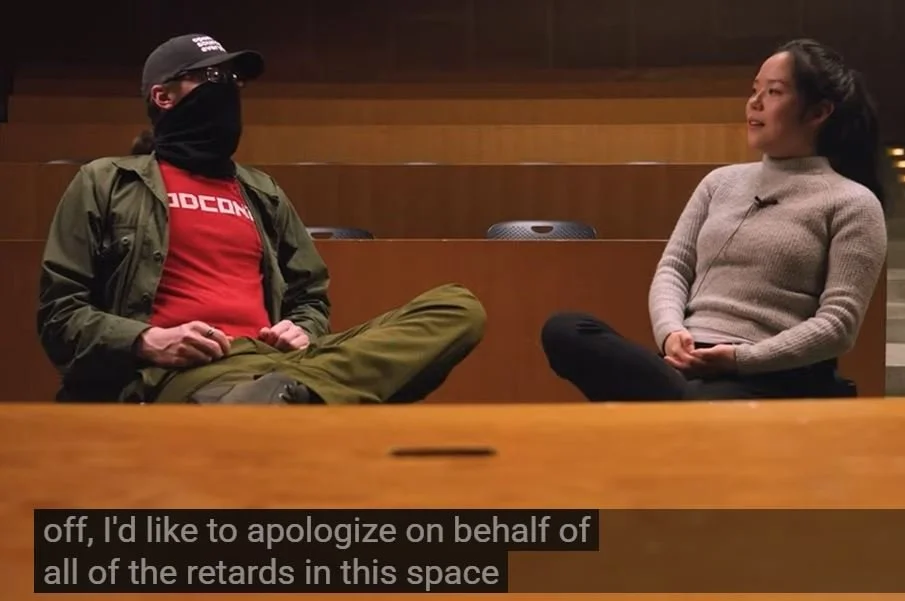
Here is what the audience listening to that exchange was not told.
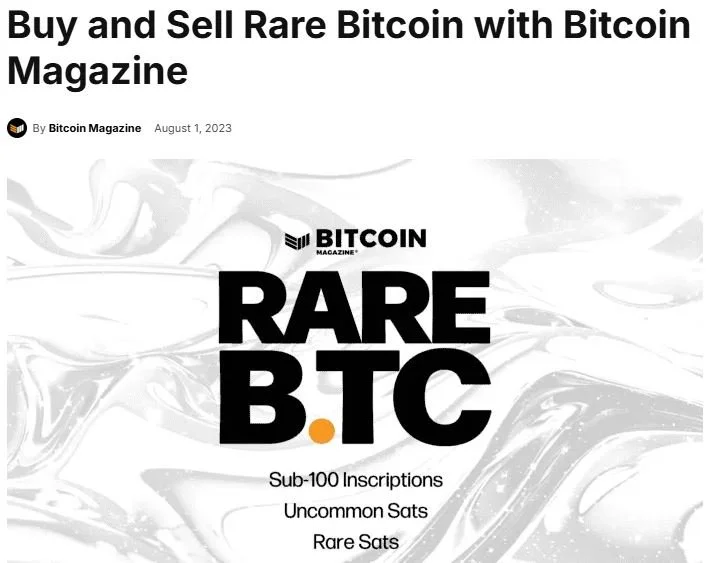
The magazine the interviewer wrote for had launched its own commercial inscriptions trading desk, Rare BTC, in 2023.
By the time of the interview, the desk had been moved to UTXO Management, the investment fund David Bailey co-founded. But both the magazine and the desk still belonged to BTC Inc, the company Bailey ran.
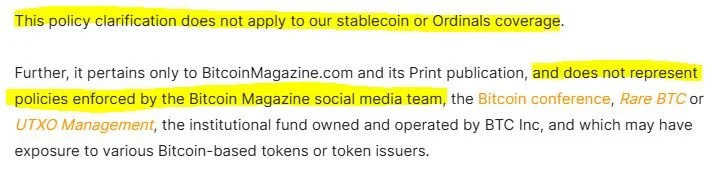
In January 2024, Bitcoin Magazine published a policy barring its journalists from covering the prices and trading of Bitcoin tokens, then said the ban did not apply to Ordinals, the market its own desk traded. The same policy put the magazine’s social media accounts, including the X account with 4.5 million followers, outside the rule altogether.
None of it reached the audience. Not in the interview, and not in the magazine's coverage of the ongoing relay-policy fight.
And the magazine's entanglement with Bailey's businesses was about to deepen.
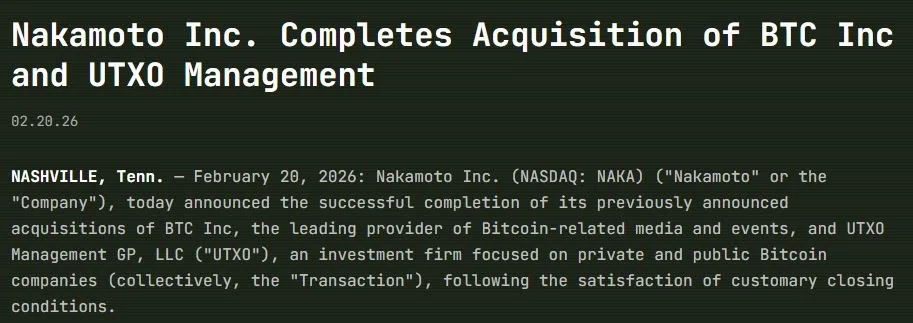
Five weeks after the interview, BTC Inc, the publisher of Bitcoin Magazine, signed on to become the paid marketing arm of Nakamoto, the Bitcoin-treasury company David Bailey was taking public through a merger with the Nasdaq-listed KindlyMD.

The same contract gave Nakamoto something more: an option to buy BTC Inc outright. Nine months later, it did.
The Bitcoin Core maintainers who decided to merge the OP_RETURN uncap sat inside a funding network the first three articles documented. This article is about the outlet that reported the story while its parent was positioned in it.
Part I: The Access
The structure this article treats as a single machine is one David Bailey presents, in his own words, as a unified whole. On a Stacker News Live appearance published July 28, 2025, defending his company against criticism, he enumerated it: BTC Inc runs, he said, "probably the biggest Bitcoin journalism outlet," "the biggest Bitcoin conference," and "the biggest Bitcoin venture fund," the three named in one breath, as one achievement.
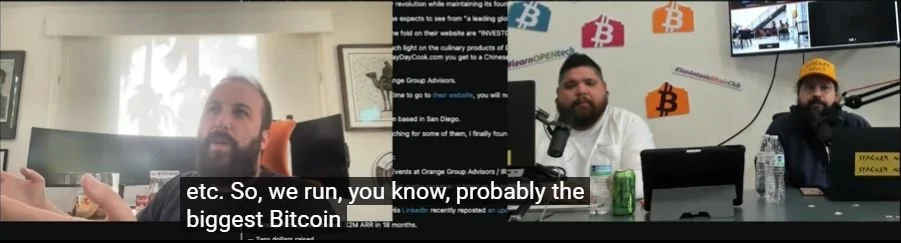
The boast is the point. The publication, the conference, and the fund are not adjacent businesses that happened to align; they are, on the chief executive's own telling, arms of one enterprise.
In 2020, the outlet's function was access. Aaron van Wirdum, who became the magazine’s editor-in-chief in 2021, bylined three pieces inside ten months covering the same institutional network: the February profile of Bitcoin Optech, the November announcement of Brink's launch, and the December announcement of Gloria Zhao's fellowship.

The Zhao piece ran the same day as Brink's own announcement, and hyperlinked back to van Wirdum's Brink launch piece. No piece disclosed any relationship, and in 2020 there may have been little to disclose. That changed.
Part II: The Desk
In 2023, the outlet became a market participant. On August 1, Bitcoin Magazine announced Rare BTC, described in its own launch post as a white-glove desk trading rare sats and inscriptions for collectors and high-net-worth investors. The publication covering Bitcoin Core's relay policy now generated revenue from the inscription ecosystem.
The same year it published the Inscription Issue, a full print edition whose Letter From The Editors declared: "Bitcoin is many things, but more than everything else, it is a database."
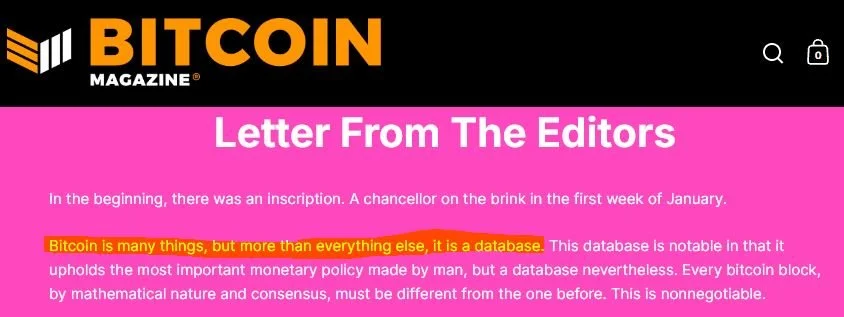
That is the philosophical position the pro-OP_RETURN uncap side would argue in 2025. In producing the issue, the magazine inscribed content onto the blockchain itself. One inscription, at block 786501, read “THE GATEKEEPERS ISSUE.” Gatekeepers referred to the developers and node operators who viewed arbitrary data on Bitcoin as harmful spam and wanted it kept off the chain.
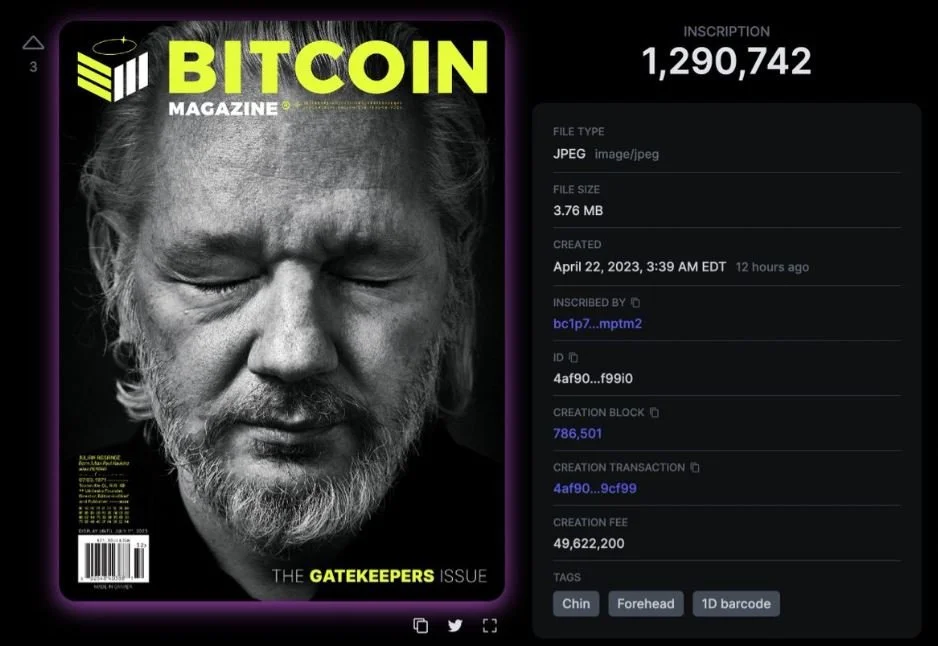
In April 2023 the magazine auctioned its first covers as Ordinals inscriptions; Bailey called the collection the start of the magazine's journey into Ordinals.
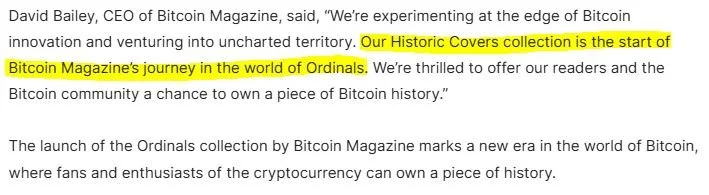
In May 2023 the magazine’s parent put the new market on the floor of its own conference. Bitcoin 2023 in Miami Beach hosted Ordinals Alley, billed in the magazine’s March 30 announcement as the first fine-art gallery for Bitcoin inscriptions, a collaboration between Bitcoin Magazine, Gamma, and Xverse. The gallery’s curation was co-led by Dennis Koch, the magazine’s art gallery director. Xverse’s own account of the show, published May 22, called it a “Bitcoin Renaissance” and listed Taproot Wizards, Bitcoin Rocks, and Bitcoin Magazine itself among the early-inscription series on the screens.
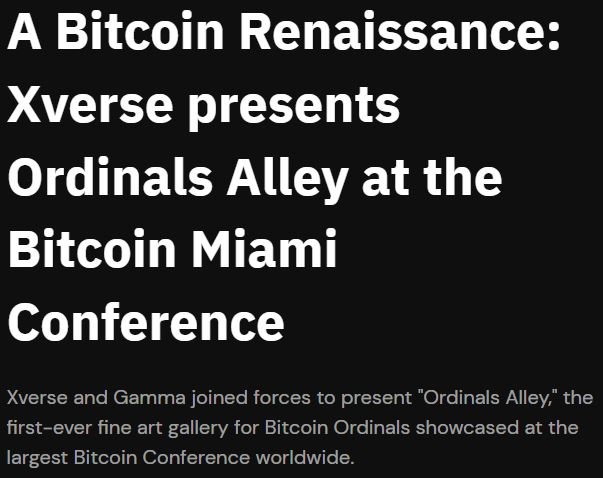
The magazine was no longer only writing about inscriptions. It was exhibiting them, at the conference it owned, beside the collections its fund would later buy.
The magazine’s name was later removed from the commercial vehicles it had launched. In March 2024, critics publicly attacked the magazine over a paid post promoting an Ordinals token and over the trading desk it ran (Part V).
The desk’s X account had been called “Rare BTC by Bitcoin Magazine” until that week, and by then the desk was being placed under UTXO Management, which, like the magazine, is owned by BTC Inc.
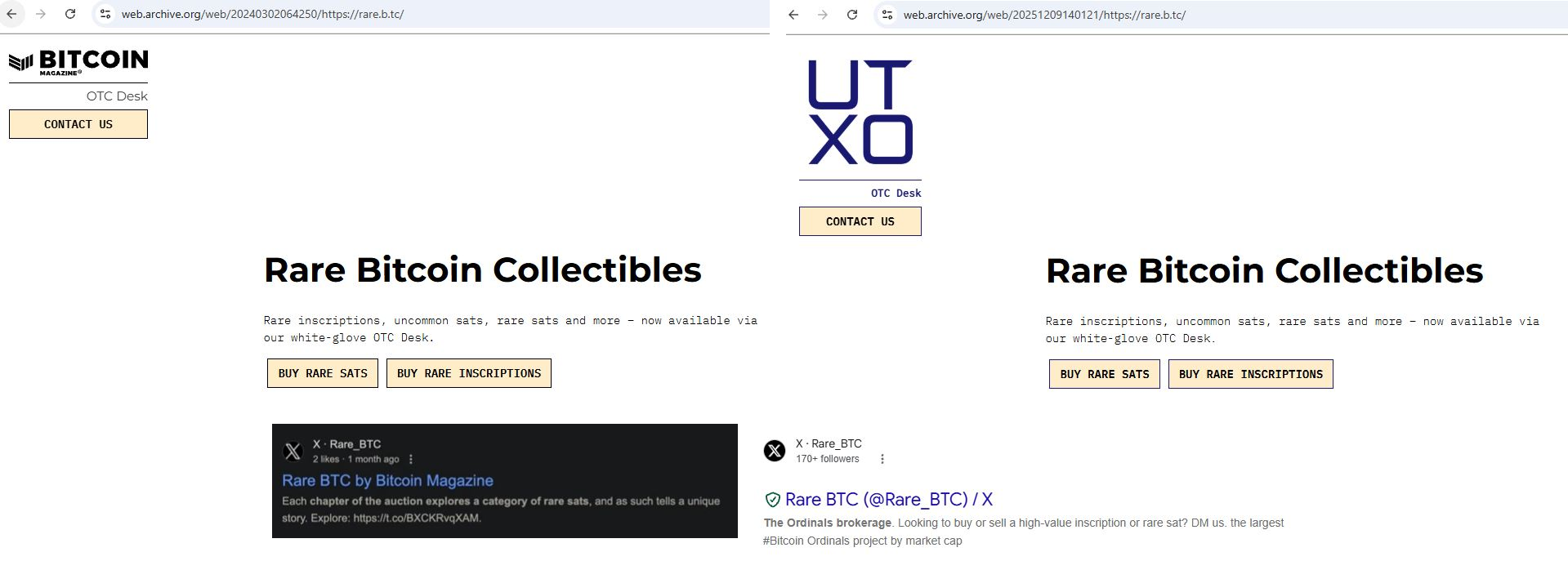
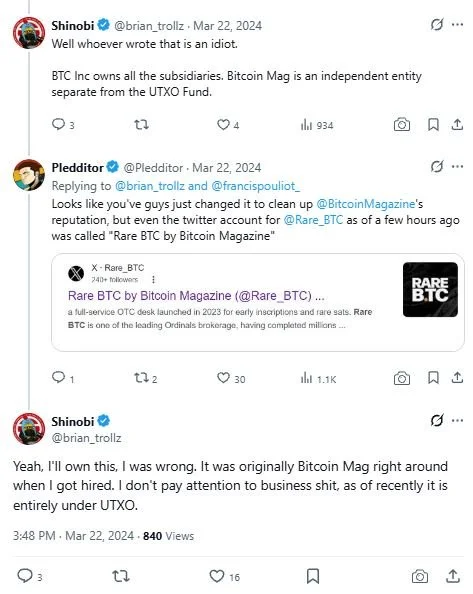
In that week’s exchange about the desk, Shinobi, the Technical and Opinion Editor of Bitcoin Magazine, first said the editorial side had nothing to do with it. Shown that the desk’s X account had been called “Rare BTC by Bitcoin Magazine” until a few hours earlier, he corrected himself: “I was wrong. It was originally Bitcoin Mag right around when I got hired.”
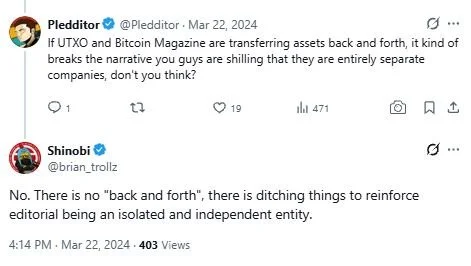
When another user replied that the two companies seemed to be transferring assets back and forth, he answered: “There is no ‘back and forth’, there is ditching things to reinforce editorial being an isolated and independent entity.”
Asked by Citadel21 what he knew, at the time of the April 2025 interview, about BTC Inc’s ownership of Rare BTC and UTXO Management and their investments in the inscriptions ecosystem, Shinobi answered: “Nothing, because I don’t give a shit about or pay attention to what the company is doing if it isn’t directly related to my work.”
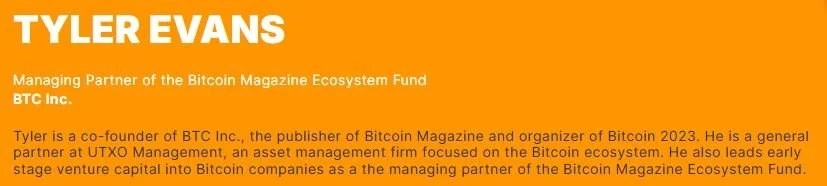
The fund followed the same rebranding path: BTC Inc's venture fund was launched and publicly promoted as the Bitcoin Magazine Ecosystem Fund, the name Tyler Evans carried in his own Bitcoin 2023 conference bio as its managing partner.
Today the same fund is presented as the UTXO Bitcoin Ecosystem Fund, its original name still fossilised in its AngelList page's web address.
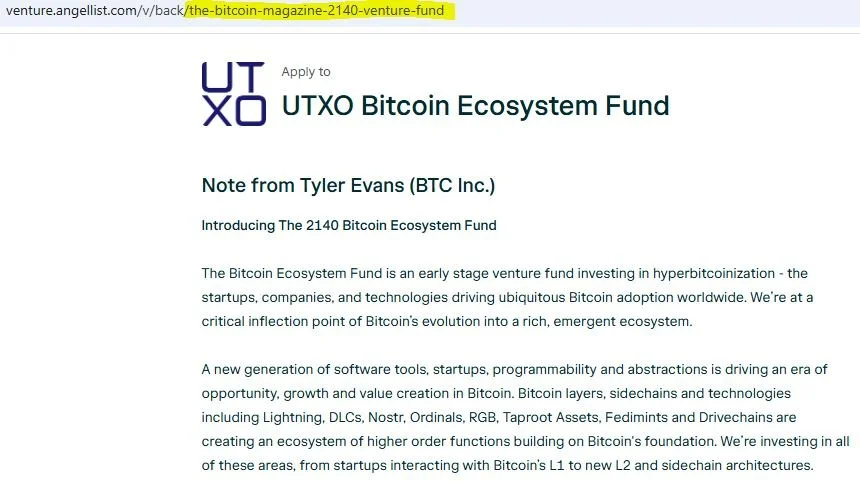
Twice, the magazine's brand was attached to a commercial at launch, and twice twice that branding was later removed. The old names survived in a web address, a conference bio, and archived pages.
Part III: The Byline
The cleanest individual instance of the conflict of interest is a single staff writer, and his arc is best told in order. The journalist writing as Namcios bylined the magazine's July 8, 2022 coverage of Zhao's maintainer appointment. He also contributed to the Inscription Issue.
On August 16, 2023, the magazine announced it was donating an inscription of its third “Historic Cover” to the Open Ordinals Institute. The announcement identified Namcios as “Bitcoin Magazine Editor and project lead of its Ordinals OTC desk, Rare BTC.”
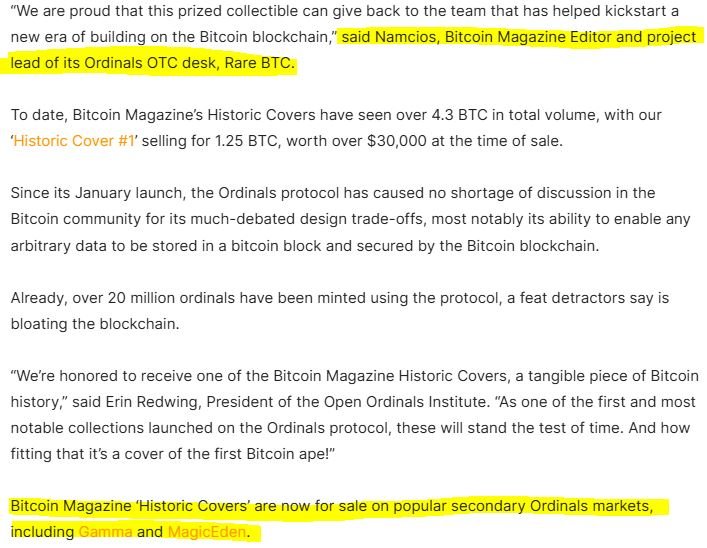
Two roles, held at once, in the company's own words.
The byline did not stop when the desk opened. It started a beat.
On the day Rare BTC launched, Namcios covered the launch of the Open Ordinals Institute, the nonprofit that would later receive one of the magazine’s covers. The piece closed with the assurance of “a promising future for the transformative Bitcoin Ordinals protocol.”
Two weeks later, he covered the debut of an Ordinals accelerator. The article quotes BTC Inc’s own chief executive praising Ordinals, without noting that BTC Inc publishes the magazine.
In September and October, he wrote two warm pieces on Chainway, the startup whose ZK rollup would later launch as Citrea, the company at the centre of Article Three.
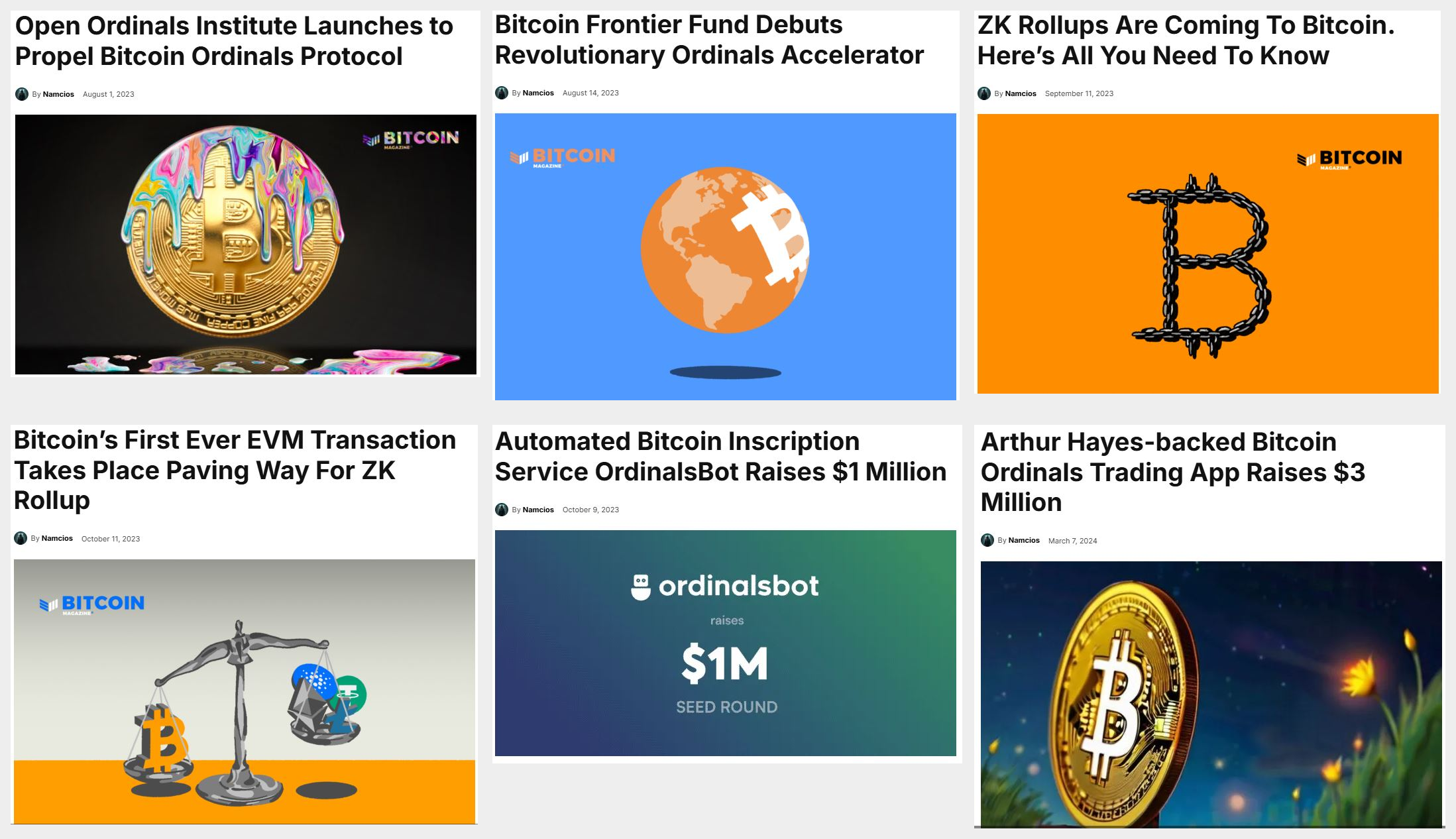
Also in October, he covered a million-dollar seed round for OrdinalsBot, an inscription company whose investors included UTXO Management itself.
His final byline for the magazine, in March 2024, covered Oyl, an Ordinals trading app whose pre-seed investors, again, included UTXO.
The OrdinalsBot piece identifies UTXO, in a parenthetical, as "the investment segment of BTC Inc, which is also responsible for publishing Bitcoin Magazine." The Oyl piece carries a formal closing disclaimer naming BTC Inc as the shared parent of both UTXO and the magazine. Twice, the corporate relationship was disclosed, both times when UTXO's own portfolio was the story.
Never, in any article, was the reader told that the writer ran the magazine's Ordinals desk. The reader was told, twice, who owned the fund. The reader was never told who was writing.
David Bailey responded to a detailed set of questions in a recorded interview on September 12, 2026; his quoted answers throughout are from that conversation.
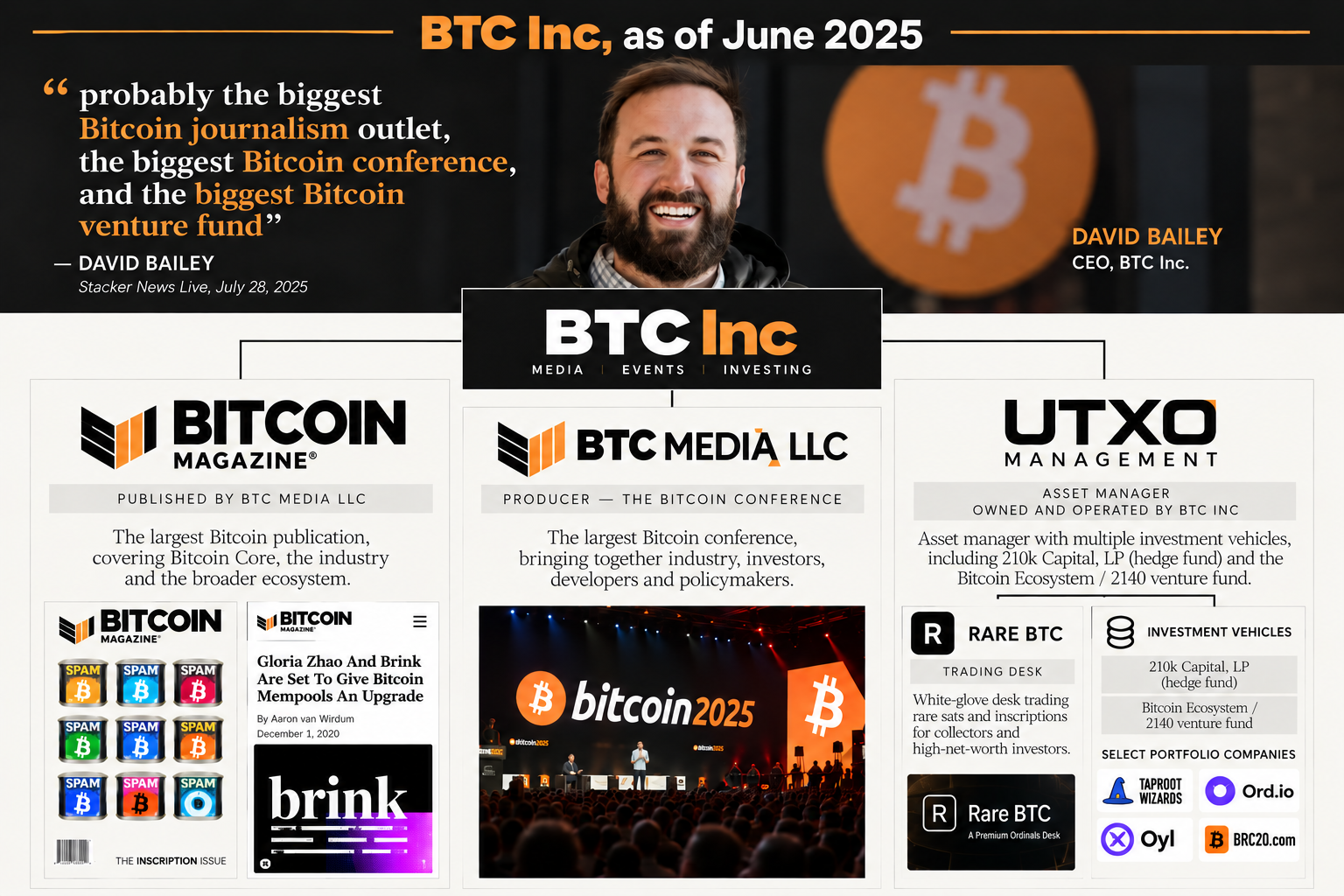
Asked about the arrangement, Bailey located it in the writer's career rather than in any scheme. The journalist was "one of the longest" and "most prolific" writers the magazine had, he said, who "ended up getting more involved on the research side and then eventually wanting to get into the investing side"; he described the OTC desk as "a very tiny pilot project." He acknowledged the disclosure gap as a transition the magazine had not yet built process for: a reader "might have found a few articles… after he made that transition, where we hadn't implemented that process yet."
Part IV: The Fund
UTXO Management, the investment arm operating under the same corporate parent as the magazine, is confirmed from primary sources as General Partner and lead investor of Unbroken Chain, the self-described first Ordinals trading fund.
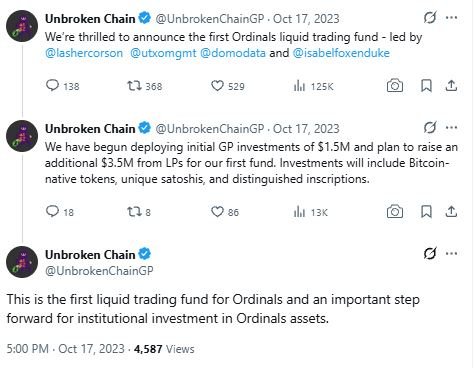
By the time the fund was publicly announced in October 2023, it had already deployed $1.5 million, including three bitcoin for a single inscribed "Bitcoin Rock."
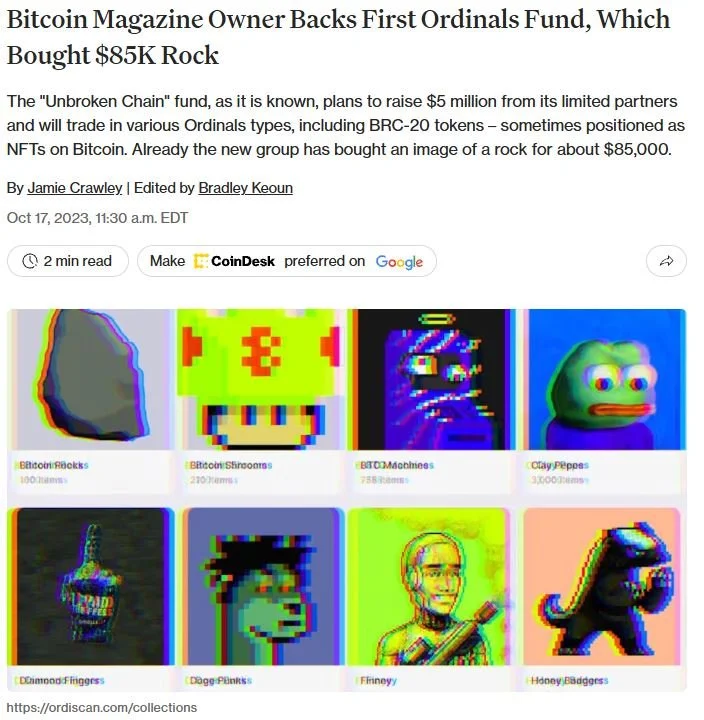
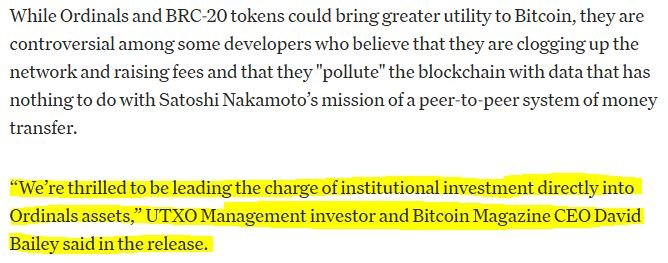
Bailey declared in the October Coindesk coverage: "We're thrilled to be leading the charge of institutional investment directly into Ordinals assets."
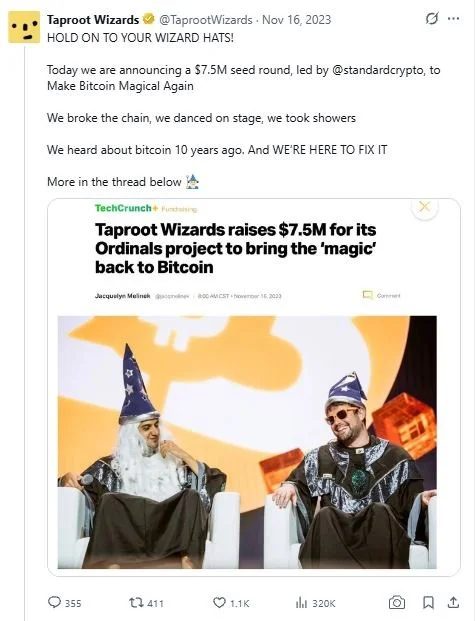
The portfolio ran straight through the companies the coverage touched. It included Taproot Wizards, the inscriptions company whose $7.5 million seed round UTXO joined in late 2023.
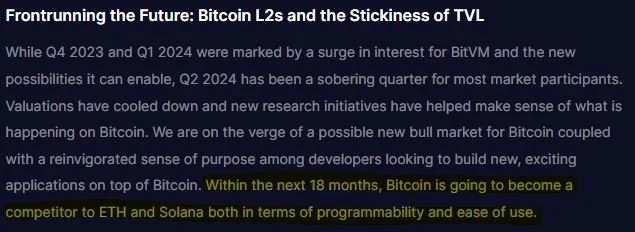
The fund treated the data layer of Bitcoin as its own terrain: its Q2 2024 quarterly report laid out the thesis in its own voice, that within eighteen months Bitcoin would become "a competitor to ETH and Solana."
And its taxonomy of what counts as a Bitcoin Layer 2 named Citrea and Alpen, the same commercial beneficiaries of the relay change Article Three documented, as examples of the category.
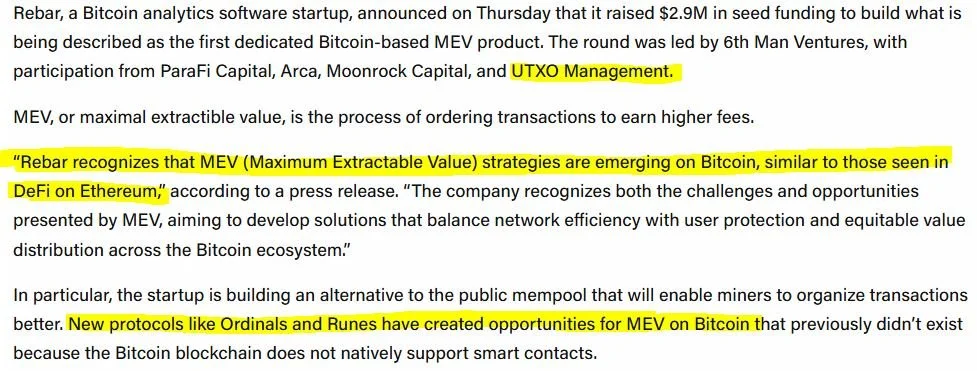
Its disclosed investments reached that terrain directly. It reached the relay layer itself, through Rebar Labs, which raised $2.9 million in June 2024 with UTXO among the investors to build an alternative to the public mempool, the very layer impacted by the OP_RETURN uncap.
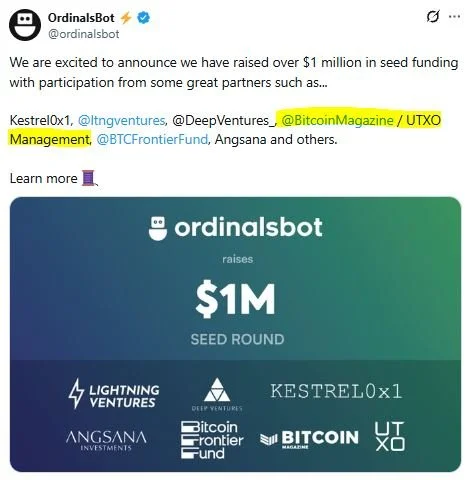
OrdinalsBot, which describes itself as the infrastructure company “powering the Ordinals ecosystem,” counted UTXO Management among the investors in its October 2023 seed round.
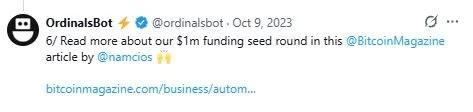
The round was covered in Bitcoin Magazine in an article written by Namcios, the magazine editor who also ran the Ordinals trading desk Rare BTC, and OrdinalsBot itself pointed followers to the article in its announcement thread of the seed round.
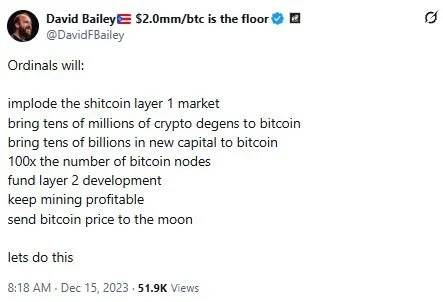
On December 15, 2023, Bailey compressed the whole thesis into a single X post: "Ordinals will: implode the shitcoin layer 1 market... bring tens of billions in new capital to bitcoin... fund layer 2 development... send bitcoin price to the moon. lets do this."
The strategy ran in the open, in Bailey's own posts, the fund's own reports, the portfolio companies' own announcements and the magazine’s social media accounts.
Against it, the magazine set a series of written editorial policies. They barred its reporters from covering token prices and trading. They carved out Ordinals, the market its own desk traded. And they placed the desk, the fund, the conference, and the magazine’s 4.5-million-follower X account outside the rules entirely.
The coverage disclosed the ownership when the fund was the story. It never disclosed that the writer of the beat ran the trading desk. The parent held the positions, the portfolio companies supplied the pitch, and the magazine carried it.
Part V: The Policy
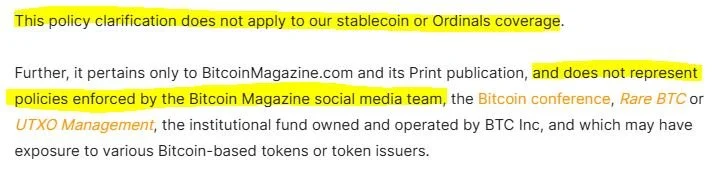
Bitcoin Magazine's Editorial Policy on Bitcoin Tokens, posted January 5, 2024, sets out what the magazine will and will not cover. It bars reporters from covering the market activity of Bitcoin tokens, their prices, trading, and performance as investments, then makes one pointed exception: the policy, it states, "does not apply to our stablecoin or Ordinals coverage."
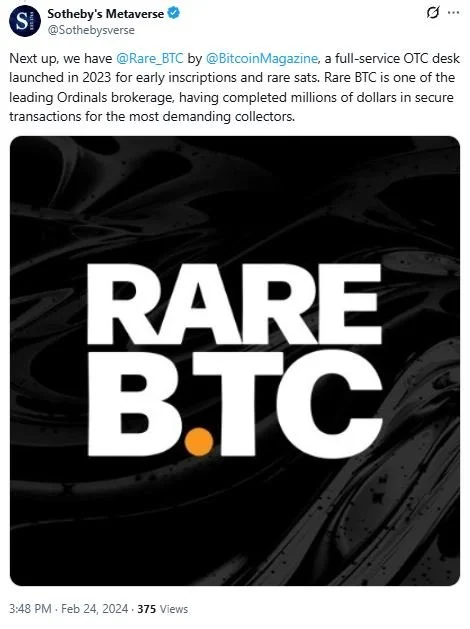
The Ordinals market activity the policy exempted from the coverage ban was the one the magazine’s own desk traded at the time. Seven weeks after the policy was posted, Sotheby’s still presented it as “Rare BTC by Bitcoin Magazine.”
And the policy closes with a second carve-out: it "does not represent policies enforced by the Bitcoin Magazine social media team, the Bitcoin conference, Rare BTC or UTXO Management, the institutional fund owned and operated by BTC Inc, and which may have exposure to various Bitcoin-based tokens or token issuers."
Asked why the policy named Rare BTC and UTXO at all, Bailey first doubted that it did. "I don't think there was an exemption for that activity," he said. When told the provision appeared in both the token and Layer 2 policies, he answered, "I don't know why we were disclosing them if that was actually in the policy. Maybe that's legalese that was drafted." He had not drafted the policy, he said.
On why disclosure was not applied evenly across the coverage, he pointed to volume: UTXO was "making hundreds of investments," some as small as $10,000, which made consistent disclosure "a logistical challenge," though the magazine, he said, "tried to have universal compliance." His broader position was that disclosure of the company's commercial relationships had been standard practice well before the 2025 deal, applied as a matter of course to articles that touched them.
A companion Layer 2 policy followed on February 21, carrying the same carve-out for Bitcoin-based L2s, but no longer saying the policy does not apply to the magazine's social media team, which the January policy did.
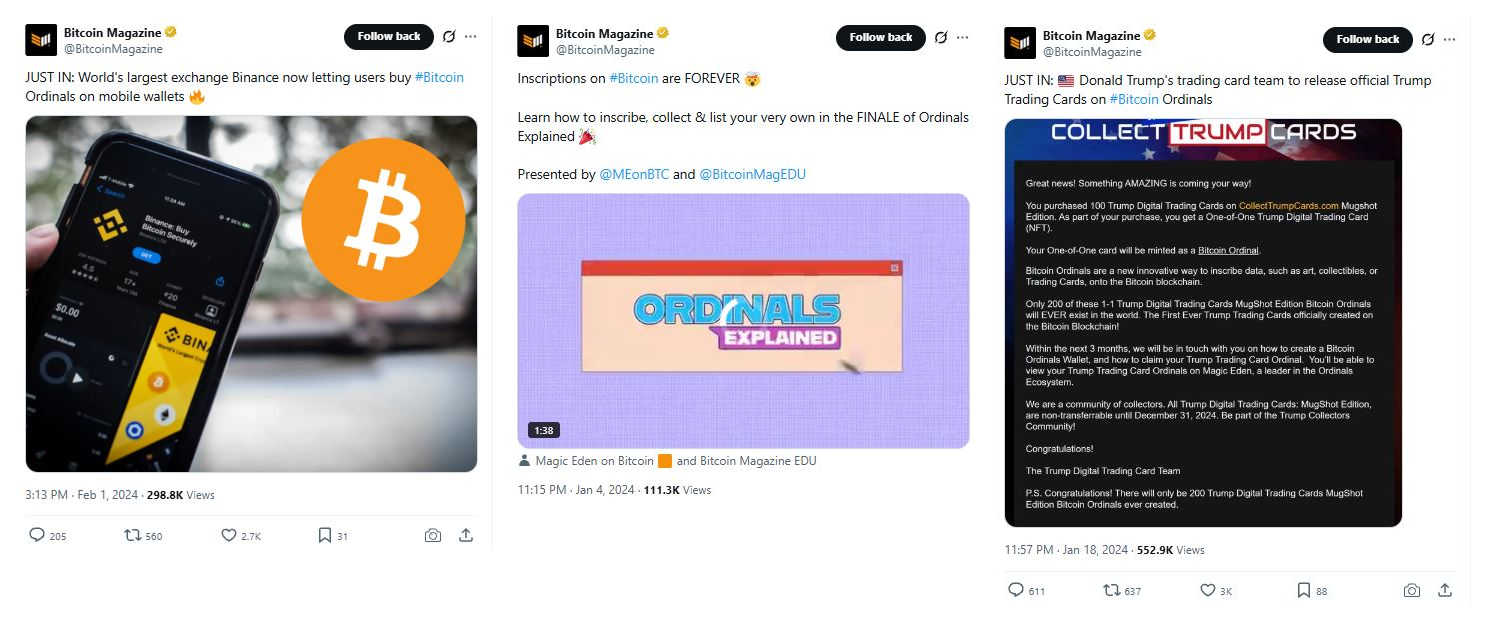
From October 2023, the Bitcoin Magazine X account ran a sponsored series, “Ordinals Explained,” “Presented by” the Ordinals marketplace Magic Eden; its finale ran on January 4, the day before the policy was published. In the weeks after, it posted a Trump-branded Ordinals trading-card drop (January 18) and a “JUST IN” post on Binance’s new Ordinals support (February 1).
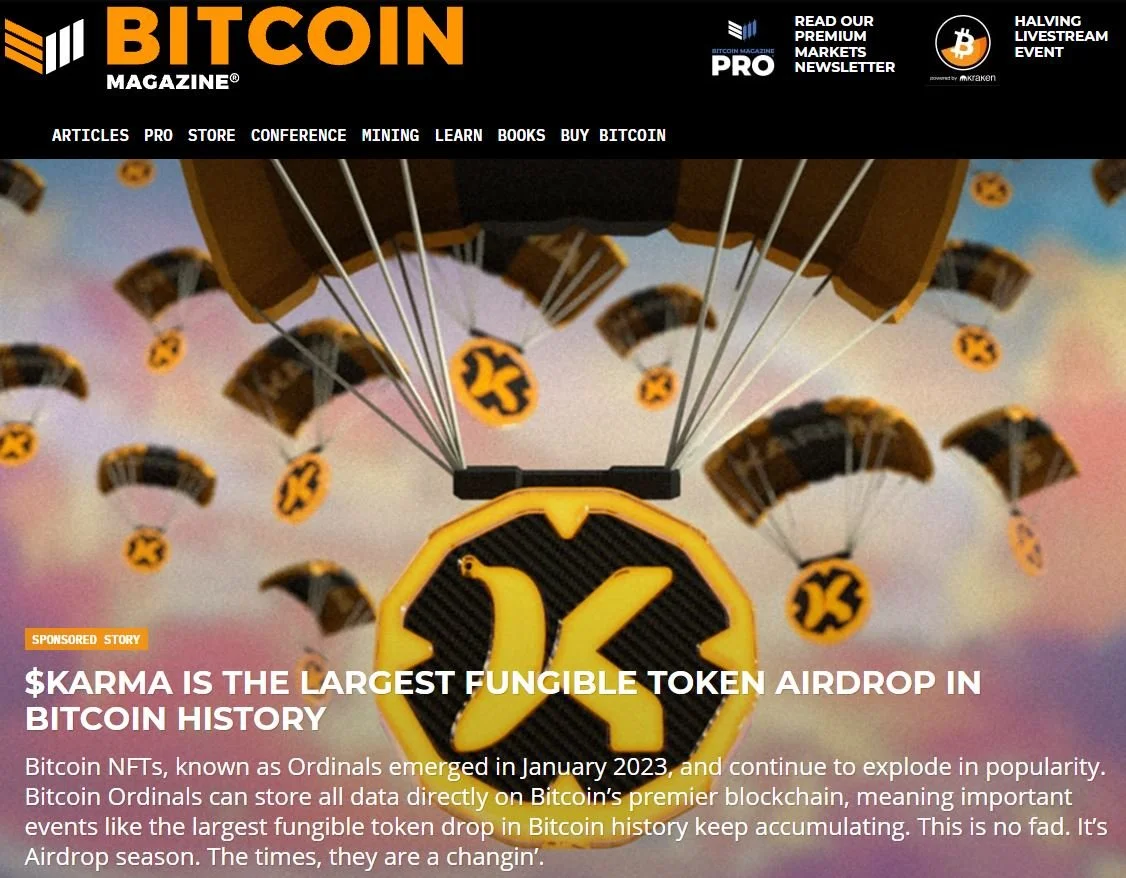
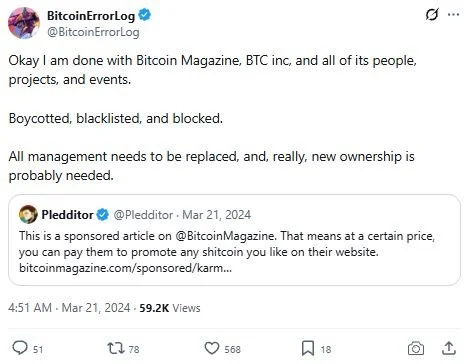
In March 2024 the magazine ran sponsored content promoting $KARMA, a token project in the inscriptions ecosystem.
John Carvalho, the chief executive of Synonym and a longtime developer, responded with an X post that drew 59,000 views that he was “done with Bitcoin Magazine, BTC inc, and all of its people, projects, and events.”
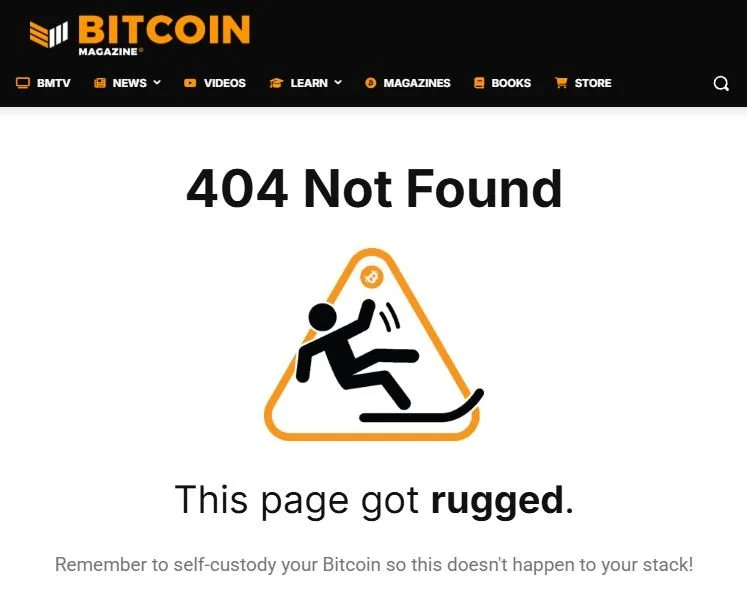
After drawing significant community outrage and criticism, the sponsored article was deleted from the site shortly thereafter. The original URL now returns a 404 branded "This page got rugged," and the piece survives only in a Wayback capture.
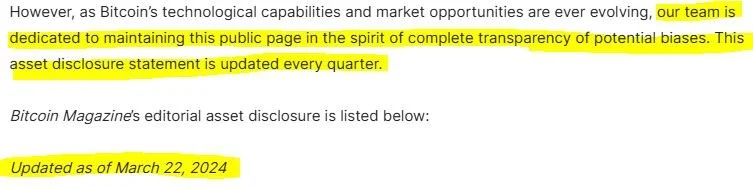
On March 22, 2024, the day after Carvalho's boycott, the magazine updated its financial-disclosures page, a staff-by-staff list of what the editorial team personally held. The page says “our team is dedicated to maintaining this public page in the spirit of complete transparency of potential biases” and that the statement “is updated every quarter.”
The page also makes clear that the disclosure "does not represent staff employed by the Bitcoin conference, Rare BTC or UTXO Management, the institutional fund owned and operated by BTC Inc, which may have exposure to various Bitcoin-based tokens or token issuers."

Despite the promise of quarterly updates in the spirit of complete transparency, the live page is still stamped “Updated as of March 22, 2024,” the same five names and the same holdings as the week of the boycott.
From that date to October 2026 is roughly ten missed quarters, including the whole period of the OP_RETURN uncap coverage, where the coverage included apologizing to Gloria Zhao on behalf of those opposing the change.
On the September 12 call with the writer of this article, Bailey credited the magazine's entire Ordinals strategy to one person: "The actual desk, the creation of the desk, in fact, the creation of our entire Ordinals strategy was really an initiative that was driven by Pete Rizzo," he said, and that Rizzo had recommended moving Namcios onto the Rare BTC trading desk.
The magazine's disclosure page shows what Rizzo himself held as of that March 2024 snapshot: inscriptions, by name, Astral Babes, Bitcoin Punks, Bitcoin Goblins, Bitcoin Wizards, and the magazine's own Historic Covers, along with ETH.
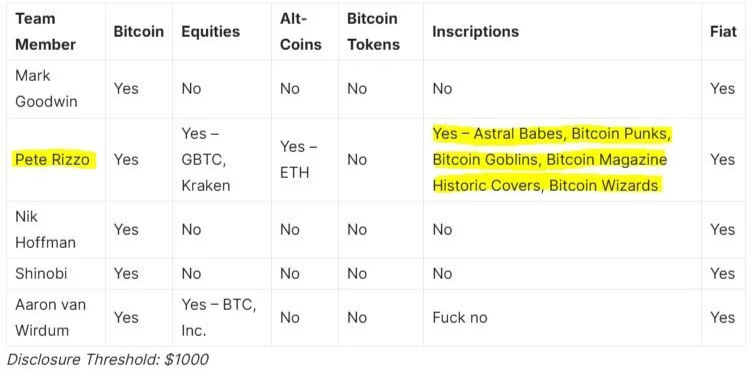
By Bailey’s account, Rizzo drove the magazine’s Ordinals strategy. He also held a personal position in the assets that strategy promoted, disclosed on a page the coverage never pointed to.
As the criticism of the $KARMA promotional content mounted, Bailey conceded the practice in his own words: "We have sponsored content, we have for years. I personally don't think that should have made it through but it did."
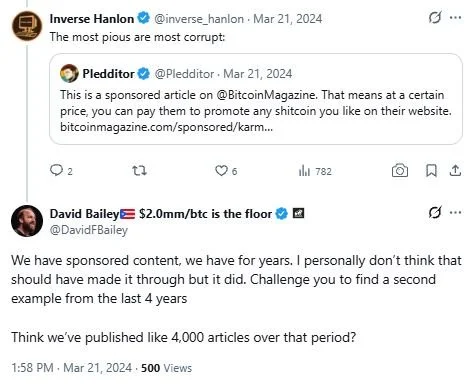
The publisher of the magazine also covering the Bitcoin relay policy fight was, by his own account, running paid promotional content, in the same ecosystem his fund was invested in.
The next day, pressed on how promotional inscriptions content cleared, the magazine’s Technical and Opinion Editor located the answer not in any writer's judgment, but in policy: the Token policy, he said, was written to "focus on technological aspects and not market movements," and the piece that started the controversy "strictly met those policy criteria to the letter, even if crossing a line I don't like."
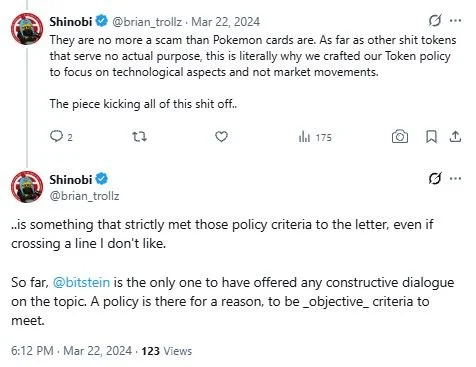
The editor's explanation matched what the policy documents showed: the rules did not necessarily exclude the sponsored content that had triggered the controversy. By his own account, the piece met their criteria.
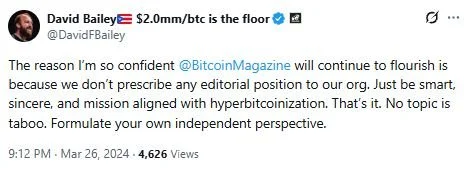
On March 26, 2024, as the complaints mounted, Bailey wrote that he was confident the magazine would flourish precisely because "we don't prescribe any editorial position to our org," asking only that writers be "smart, sincere, and mission aligned with hyperbitcoinization," with no topic being taboo.
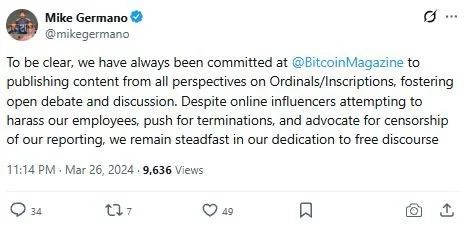
The same day, the magazine's president, Mike Germano, posted on X that the publication had "always been committed... to publishing content from all perspectives on Ordinals/Inscriptions, fostering open debate," and remained "steadfast in our dedication to free discourse."
But the record of that week shows the complaint was not about reporting, or viewpoints, or free discourse at all. It began when the user “Pledditor” posted that "this is a sponsored article on @BitcoinMagazine. That means at a certain price, you can pay them to promote any shitcoin you like on their website."
John Carvalho, the day before announcing his boycott, had made it clear that the objection was commercial, not just editorial: "we don't care only that they are owned by a shitcoiner, we care that, for whatever reason, they are becoming more scam-tolerant and it is affecting their products/events."
Francis Pouliot's thread, the one that surfaced Shinobi’s admissions, was about the OTC desk, not the opinion page: "I didn't realize until just now Bitcoin Magazine was actually running an ordinals OTC desk."
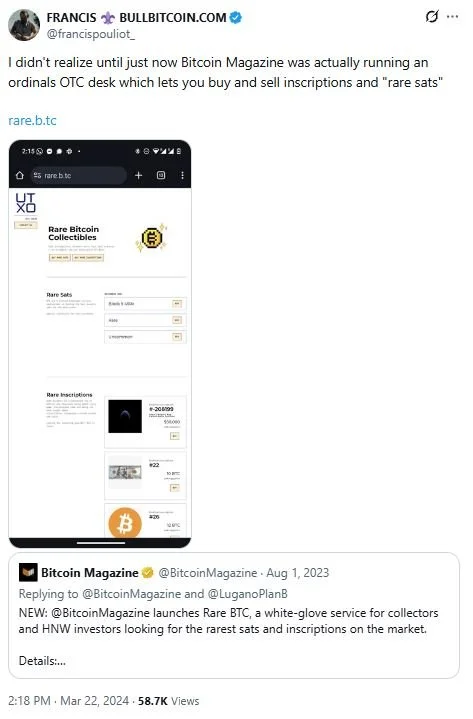
The words that recur across the criticism are “sponsored”, “scam-tolerant”, “OTC desk”, “conflict of interest”, “boycott”. The nearest thing to Germano's "push for terminations" was Carvalho's view that the company's management should be replaced, not a call to censor anyone's reporting.
On the call with this publication, Bailey answered the larger question, whether the magazine’s coverage tracked its commercial interests.
The company’s support for Ordinals, he said, was “ideological”: “the commercial side was not a motivating factor at all.”
He traced it to what he called “the old-school Bitcoin maximalist view that Bitcoin can eat all the things,” which he said he set out in a 2018 essay, "Make Bitcoin Fun Again." Commercially, he said, the Ordinals desk was “just a drop of water in the ocean,” and of Ordinals as a whole, “we could have made like $0 and we wouldn’t even notice the difference.” He cast the inscriptions fight as an ideological divide: his side “took a principled ideological stand and took a lot of blowback for it.”
He made a parallel point about editorial control. No one, he said, tells the magazine’s writers what to write, and Shinobi, the editor who apologized to Zhao, least of all: “if I tried to tell Shinobi what to do he would tell me to go fuck myself and he’d resign.” The company was “the most hands-off,” its newsroom a “fucking free-for-all” with “no adults in the room telling people like they have to do this or do that.”
Asked by Citadel21 whether anyone at BTC Inc had given him direction about his coverage, Shinobi gave the same account: “I have full and complete autonomy and self-direction when it comes to all content I produce. I have occasionally been asked to cover specific subjects that are pertinent to recent events, I have never been asked, told to, or suggested to cover any topic in such instances any specific way, to portray them in any specific context, or anything of the sort.”
Shinobi followed his denial with a remark about the investigation: “I can’t wait to see how you delusionally try to spin drug-addled conspiracy theories about me being directed by ‘nefarious influence in the company’ to ‘tow the company line.’”
Part VI: The Guest Channel
Twice, the magazine’s guest channel carried advocacy that touched its parent’s investments.
On November 30, 2023, Bitcoin Magazine's technical section ran a long guest article by Danny Yang, the founder of Metagood and OnChainMonkey, making the case for Ordinals and built substantially around Metagood's own OCM collection. It carried the standard guest-post disclaimer, that the opinions were his own and did not necessarily reflect those of BTC Inc or Bitcoin Magazine, and nothing more.
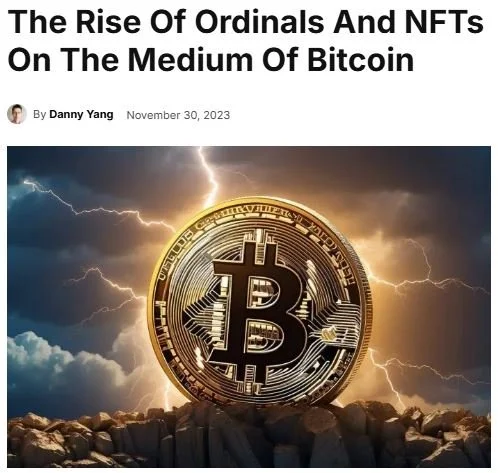
Fourteen days later, on December 14, Bitcoin Magazine reported that Metagood had raised five million dollars.
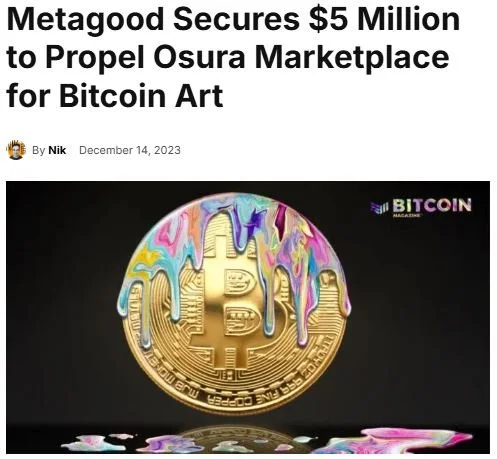
It named UTXO Management, the magazine’s own parent’s fund, among the investors, and closed with a disclaimer that UTXO and the magazine shared a parent. The guest piece two weeks earlier had carried no such line.
Bailey’s answer is that the magazine could not disclose an investment before it was made; this article could not establish when UTXO committed to the round.
Metagood’s best-known product is OnChainMonkey: ten thousand cartoon-monkey profile pictures given away in a free mint on Ethereum in September 2021, then moved onto Bitcoin as Ordinals inscriptions in 2023. The collection spun off 3D “Karma” monkeys, made by feeding each original monkey a “Dessert” NFT, and a generative series called OCM Dimensions.
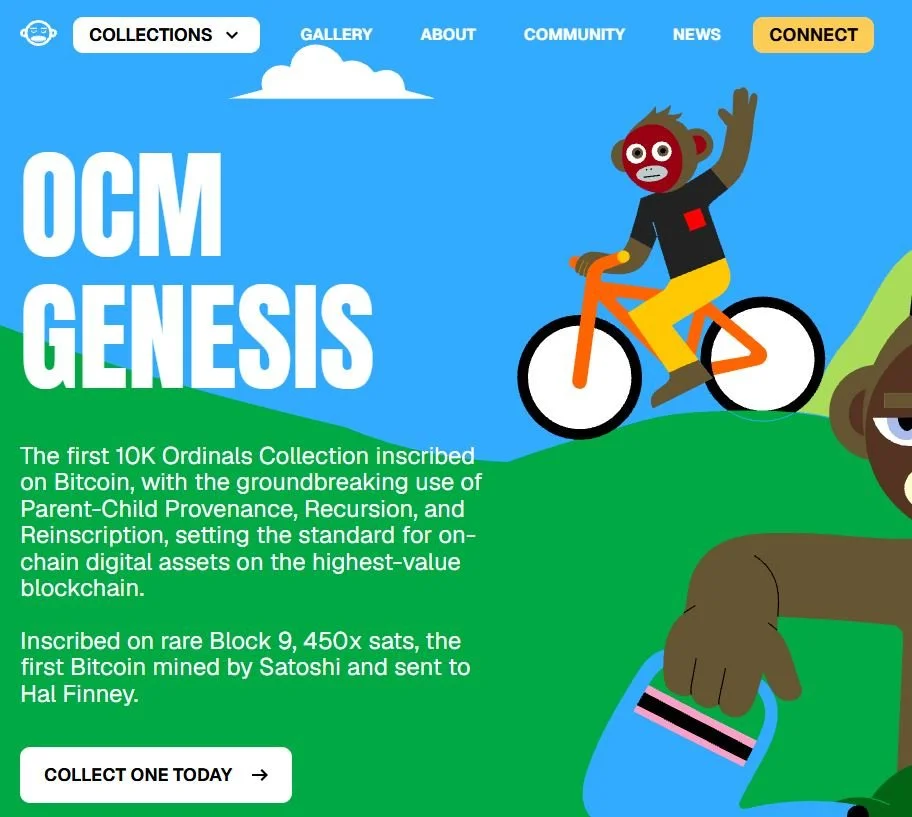
The same ecosystem would surface again three months later, when the magazine ran a paid promotion of the $KARMA airdrop, the drop that rewarded holders of those very OCM collections, the sponsored post that drew John Carvalho’s boycott.
The guest channel ran a second time, on the same pattern. On April 15, 2024, the magazine published a guest piece by Yves La Rose, the chief executive of the EOS Network Foundation, arguing that Bitcoin and Ethereum should stop warring and converge.
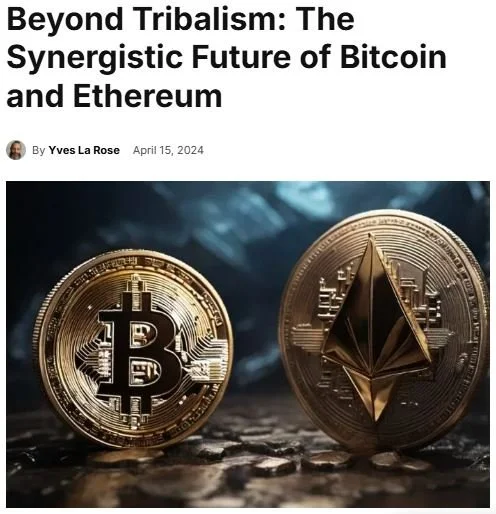
It carried the magazine's standard guest disclaimer, that the opinions were La Rose's own and "do not necessarily reflect those of BTC Inc or Bitcoin Magazine."
What it did not note was that BTC Inc's fund had, nineteen days earlier, taken a position in exactly that thesis. On March 27, 2024, UTXO Management joined the $10 million seed round of BOB, "Build on Bitcoin," a self-described "first-of-its-kind hybrid Layer-2 powered by Bitcoin and Ethereum", the convergence trade the piece was making the case for.
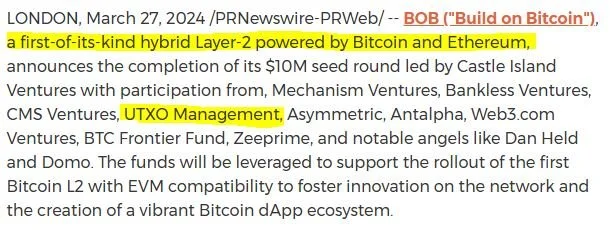
The La Rose article disclaimer told readers the view was not BTC Inc's. It did not tell them BTC Inc's fund was invested in BOB. The magazine ran convergence advocacy as editorial while its parent's fund held the convergence trade, and the reader was told the first and not the second.
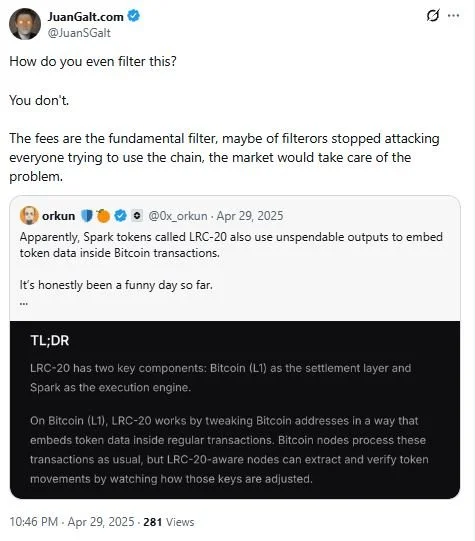
Twenty-seven days before Gloria Zhao merged the OP_RETURN uncap into Bitcoin Core on June 9, 2025, the magazine published a technical explainer article by staff writer Juan Galt. The explainer’s framing matched its author’s own stated position. In the same weeks Juan Galt wrote the piece, he was on X siding openly with the uncap.
He called the opposition “filterors”, claiming they were “attacking everyone trying to use the chain”.
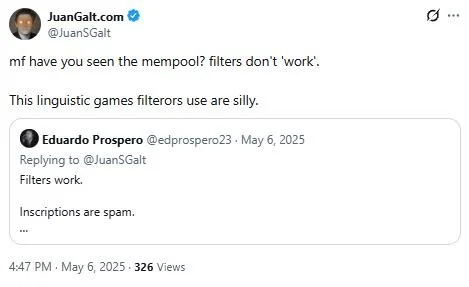
Arguments from those against the OP_RETURN uncap were dismissed with “the linguistic games filterors use” as “silly.”
The explainer carried the same tilt. It presented “harm reduction”, the pro-uncap camp’s own framing for the proposal, as the neutral description, stating in the magazine’s own voice that removing the limit “represents a harm reduction approach to the problem of spam,” while consistently attributing the opposing view to “the Filterors.”
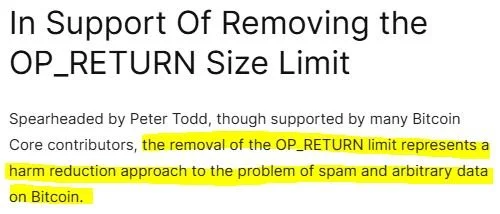
The article carried a note calling itself “a general (and probably incomplete) overview” of the arguments on both sides. Even so, it presented the pro-uncap camp’s own framing, in the magazine’s own voice, while attributing the opposing view to “the Filterors.” And its author was not a neutral surveyor of the debate, but siding openly with the uncap on X.
Two weeks before the merge, the commercial engine put the position on physical display. At Bitcoin 2025 in Las Vegas, BTC Inc’s conference built a thirty-foot “Ordinals Dome” and ran an exclusive auction of inscription works inside it.
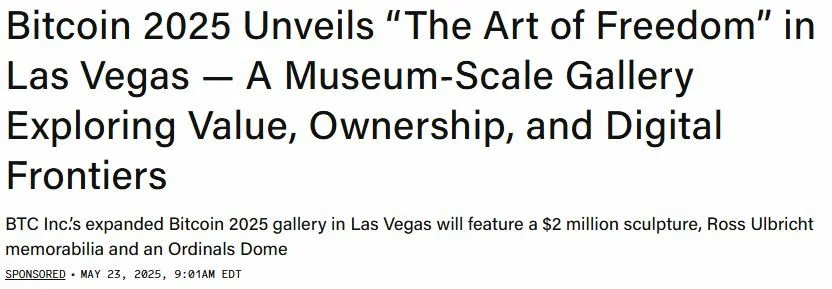
At the same time, its stage agenda gave four sessions to speakers from Citrea and Alpen Labs, the Layer-2 companies Article Three named as commercial beneficiaries of the change. Topics included “How Citrea Enables ₿apps” and “Bitcoin as an Application Platform: The Future of Computation.” Two weeks before a relay-policy change in the direction that would make such applications easier to build, the companies poised to build them had the conference’s stage.
That is the context in which Shinobi’s apology “on behalf of all of the retards in this space” to Gloria Zhao was offered, and accepted, on air. Nothing in the record suggests the apology was anything other than his own view; what matters is what the audience listening to it was not told.
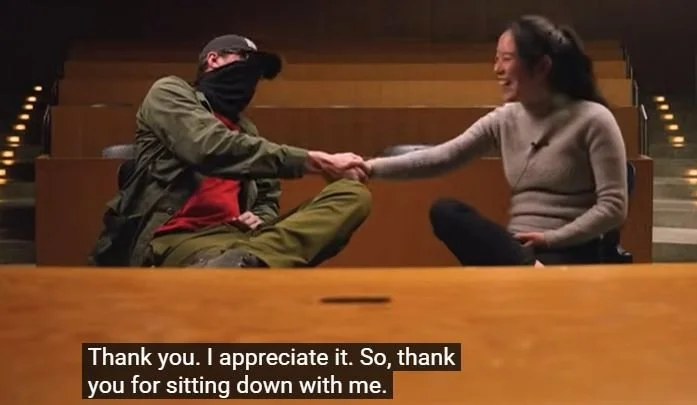
The loop closes where this article began: a magazine that had itself published a print issue advocating the inscriptions thesis, apologising to a developer on behalf of her critics, while around it stood an inscriptions trading desk and a fund invested in the businesses the change favored. None of it was disclosed in the interview, or in the magazine’s coverage of the relay policy fight.
And within weeks of that interview, a contract would be signed that priced the earnings of the magazine’s parent into its owners’ payout.
Part VII: The Contract
On May 12, 2025, Nakamoto, a holding company David Bailey had founded, announced that it would merge with the Nasdaq-listed KindlyMD to create a public Bitcoin treasury company.
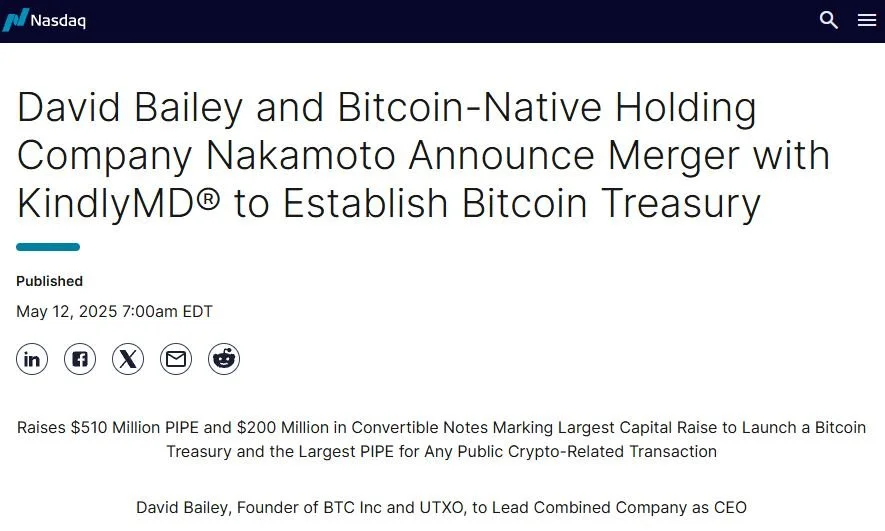
It was backed by $710 million: a $510 million sale of shares to selected investors, known as a “PIPE”, and $200 million in convertible notes.
Its announcement billed the deal as the “Largest Capital Raise to Launch a Bitcoin Treasury and the Largest PIPE for Any Public Crypto-Related Transaction.” Bailey would lead the combined company as chief executive.
The same day, he signed a contract with Nakamoto on behalf of BTC Inc, the company that publishes Bitcoin Magazine, as its chief financial officer.
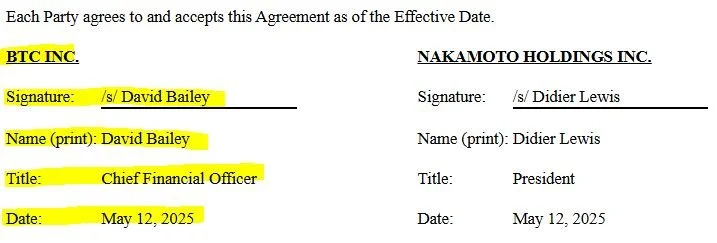
On its face, the contract (the “Master Marketing Services Agreement”), made BTC Inc the treasury company’s paid marketer, for a retainer the filings put at $80,000 a month. The publisher of Bitcoin Magazine was set to become the paid marketing arm of a Nasdaq-listed Bitcoin treasury vehicle.

Section 12 of the contract made it something more: a sale in waiting. It gave the public company the right to buy all of BTC Inc.

The price was set by formula: BTC Inc’s earnings multiplied by at least ten, paid in the public company’s stock, with the earnings counted from January 1, 2025.
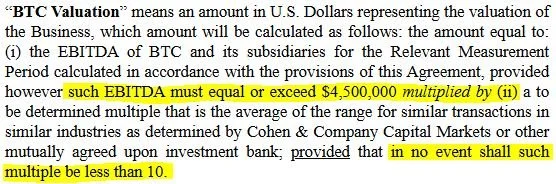
That window included the months in which Bitcoin Magazine covered the OP_RETURN fight. No evidence shows any article was shaped by the formula. The record shows that it existed, in a signed contract, while the coverage ran.
Another clause, Section 8(f), reads: “Both Parties agree that during the Term they will neither give any information to nor interviews with any media regarding the Agreement or the Parties’ relationship, nor will they allow or otherwise permit their employees to do so.”

Signed by the company that publishes Bitcoin Magazine, that is a promise of silence about its owner’s own deal. For the four-year term, BTC Inc agreed not to give the media any information about its relationship with the treasury company, and not to permit its employees to do so.
Bailey said he “wasn’t familiar or really aware of that bar,” and that “every writer at Bitcoin Magazine who writes any article that is related to Nakamoto is putting a Nakamoto disclosure on it.” “I don’t run Bitcoin Magazine day to day,” he added; he is “removed from the process, and intentionally so.” No such disclosure appeared on the magazine’s relay-policy coverage.
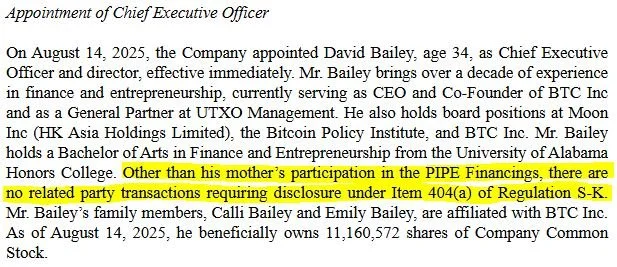
The owners on the selling side were, above all, Bailey and his mother, Calli Bailey, who received the two largest allocations when the sale closed. The filing announcing his appointment as the public company’s chief executive said he had no related-party transactions beyond his mother’s PIPE investment.
The company’s next quarterly report treated BTC Inc as a related party.
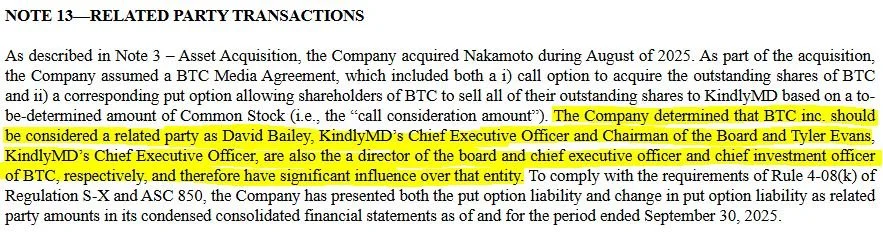
Bailey said he could not speak to “the MSA in that stage of the process,” which he called “a legal question” for the company’s lawyers. “In general, this was a related party transaction,” he said. “We followed the correct process.”
Every term of this was filed with the SEC, where investors could read it. Bitcoin Magazine’s readers were told none of it.
The Nakamoto investor list, itemised in the SEC-filed registration statement of September 12, 2025, reaches back into the coverage of this series of articles. Among the named individual investors is Danny Yang, founder of Metagood and OnChainMonkey, the company whose promotional guest piece ran on Bitcoin Magazine without disclosure of the UTXO tie.
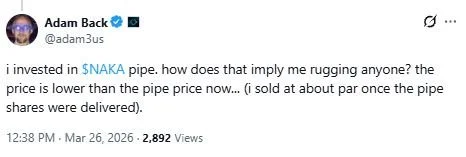
Two other names mentioned in the earlier articles appear in the same registration statement’s list of Nakamoto investors: Adam Back and Jameson Lopp. Back said in March 2026 that he “sold at about par once the pipe shares were delivered”. Lopp lists the holding on his own investment page.
Part VIII: The Sale
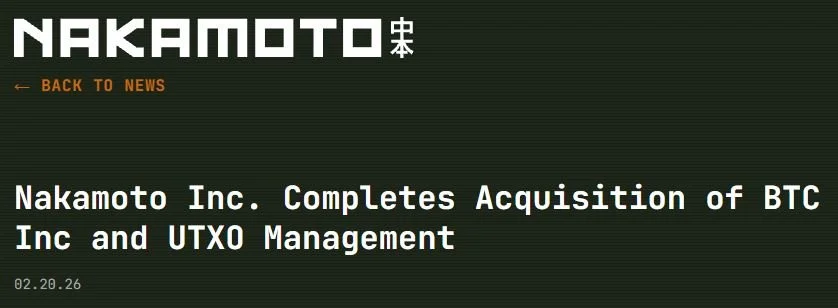
Nakamoto’s right to buy BTC Inc did not stay on paper. On February 16, 2026, the company used it. A later SEC filing records the moment: Nakamoto “exercised its call option to acquire both UTXO Management GP, LLC and BTC Inc., as permitted in the MSA agreement amongst the parties that was signed in 2025.”
The deal closed on February 20. Bitcoin Magazine’s publisher, and the fund behind its Ordinals ventures, are now owned outright by the treasury company.
The price was set the way the May 2025 marketing contract said it would be: by BTC Inc’s earnings, multiplied by at least ten. In the twelve months to September 2025, which took in the OP_RETURN fight, those earnings (EBITDA) came to about $20.6 million, by Nakamoto’s own figures. (When the purchase was signed, the parties moved the contract’s start date back a year to allow that window; Bailey says it was always meant to be a trailing twelve months, and that the change slightly lowered the price.)

And the company was valued at about $377 million: roughly eighteen dollars for every dollar of earnings.
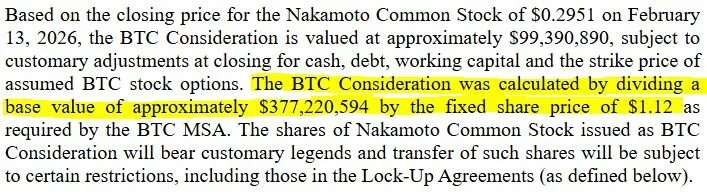
With the fund included, the sellers received about 365 million shares, worth roughly $409 million at the deal’s $1.12 share price.

Bailey says his side came out of the deal badly. The number of shares was fixed using the $1.12 price, but by the time the deal closed the stock had fallen to about 25 cents, and Nakamoto valued the payment at about $81.6 million. “We really hurt ourselves by following through with the transaction,” he said.
Most of it went to two people. Bailey and his mother, Calli Bailey, received about 230 million shares between them, each, in the filing’s words, a “pro rata portion.” At the market price on the day before closing, that came to about $57 million: roughly $30 million for him and $27 million for her.
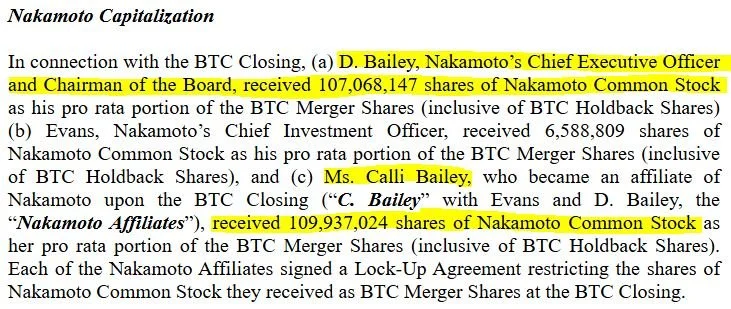
Bailey said the split reflects the company’s founding, when he divided ownership equally with her, and that counting shares set aside for employees’ stock options makes the family’s portion smaller. Either way, Bitcoin Magazine’s parent was a closely held family company.
The man who co-founded Bitcoin Magazine’s parent raised roughly half a billion dollars of other people’s money into a public Bitcoin treasury company. On the day the deal was announced, he signed a contract giving that company the right to buy his media business from its owners, chief among them himself and his mother, at a multiple of its earnings. The contract also barred both sides from talking to the media about the relationship.
The Space
In July 2026, months after the sale, Bailey spent an evening in an X Space titled “WILL BIP-110 FAIL?” arguing against the filter proposal, which he said would mean “Bitcoin eventually is doomed to capture.” Describing what he called an information war against the network, he said the other side had “been kind of successful,” that “they got one of our best developers to resign.” Another participant objected: “Gloria is not one of the best developers, David.” Bailey did not dispute the identification. In April 2025, it was his magazine that had apologised to her, on air, on behalf of her critics.
A Note on What This Story Is and Is Not
The subject of this article, David Bailey, responded at length, on the record, over the course of an hour; his answers are represented throughout, beside the claims they address. This article does not claim that any investor's advocacy was compensated, that any editor was instructed to slant coverage, or that the interview was bought. Nor does "capture," as this series uses the word, mean a conspiracy: it names a property of structure, concentrated funding, aligned incentives, undisclosed positions, a megaphone with a balance sheet, and requires no one's intent. The conflicts it documents exist whether or not they were acted upon.
The defenders' reading deserves stating. On that reading, this is normal media commerce in a small industry, a fund investing where its thesis pointed, and coincidental timing in a fast-moving market.
Grant that reading in full. Grant that everyone acted independently and in good faith. The magazine’s readers were still not told that its parent ran an inscriptions desk, held stakes in companies it covered, and had signed a contract tying its own sale price to its earnings. That finding does not depend on anyone’s intent.
The reader who believes every actor behaved honourably is still left with the question this series has asked from the start: whether infrastructure whose entire claim is trustlessness can be stewarded by a structure that requires this much trust.
Right of Reply
Before publication, Citadel21 sent questions to the people named below.
David Bailey, chief executive of Nakamoto Inc., received detailed written questions on August 30, 2026. He replied in writing and then answered the questions on the record in a recorded call on September 12, 2026. His quoted answers in this article are from that call, and he reviewed and approved a summary of his positions before publication. At his suggestion, questions about Bitcoin Magazine’s editorial and disclosure policies were also sent to Brandon Green, BTC Inc’s chief executive since November 2025. Green had not responded by publication.
Shinobi, Bitcoin Magazine’s Technical and Opinion Editor, received written questions on October 11, 2026. He replied on October 12. His answers are quoted in full in Parts II and V, along with a remark about the investigation, in Part V.
Pete Rizzo, Namcios and Juan Galt each received written questions on October 11, 2026, about the passages that concern them. None had responded by publication. Any response received later will be added to this article as an update.
Sources
Series
CAPTURE, Article One: The Network. https://www.citadel21.com/the-network
CAPTURE, Article Two: The Lever. https://www.citadel21.com/the-lever
CAPTURE, Article Three: The Merge. https://www.citadel21.com/the-merge
The Apology and opening
Bitcoin Magazine, interview with Gloria Zhao, April 8, 2025 (video). https://www.youtube.com/watch?v=lW8r9hq8-yU
Bitcoin Core PR #32406, merged June 9, 2025. https://github.com/bitcoin/bitcoin/pull/32406
Bitcoin Magazine, “Buy and Sell Rare Bitcoin with Bitcoin Magazine,” August 1, 2023. https://bitcoinmagazine.com/markets/buy-and-sell-rare-bitcoin-with-bitcoin-magazine
CoinDesk, UTXO Management / 210k Capital, April 9, 2025. https://www.coindesk.com/business/2025/04/09/this-bitcoin-hedge-fund-is-taking-treasuries-companies-global-blockspace
Bitcoin Magazine, Editorial Policy on Bitcoin Tokens, January 5, 2024. https://bitcoinmagazine.com/markets/clarifying-bitcoin-magazine-editorial-policy-on-bitcoin-tokens
Bitcoin Magazine on X (follower count). https://x.com/BitcoinMagazine
KindlyMD/Nakamoto merger announcement, May 12, 2025 (SEC copy, Exhibit 99.1). https://www.sec.gov/Archives/edgar/data/1946573/000121390025041722/ea024162001ex99-1_kindly.htm (also republished on nakamoto.com, posted May 20, 2025)
KindlyMD Form 8-K, filed August 15, 2025 ($80,000 retainer; appointment and Item 404(a) statement). https://www.sec.gov/Archives/edgar/data/1946573/000121390025077579/ea0252980-8k_kindly.htm
Part I
Stacker News Live, “SNL vs David Bailey,” July 28, 2025. https://youtu.be/JNLN5lmXkMw?t=431
Bitcoin Magazine, Bitcoin Optech profile, February 2020.* https://bitcoinmagazine.com/technical/how-bitcoin-optech-is-connecting-the-open-source-and-corporate-worlds
Bitcoin Magazine, Brink launch, November 2020.* https://bitcoinmagazine.com/technical/john-newberys-new-nonprofit-brink-will-train-and-support-bitcoin-developers
Bitcoin Magazine, “Gloria Zhao and Brink Are Set to Give Bitcoin Mempools an Upgrade,” December 1, 2020. https://bitcoinmagazine.com/technical/gloria-zhao-and-brink-are-set-to-give-bitcoin-mempools-an-upgrade
Brink, fellowship announcement, December 1, 2020. https://brink.dev/blog/2020/12/01/gloria/
Part II
Bitcoin Magazine store, The Inscription Issue. https://store.bitcoinmagazine.com/pages/the-inscription-issue
Bitcoin Magazine, Historic Covers auction, April 2023.* https://bitcoinmagazine.com/culture/bitcoin-magazine-announces-historic-nft-auction
Bitcoin Magazine, “Miami Bitcoin Conference Will Have Ordinals Alley Art Gallery,” March 30, 2023. https://bitcoinmagazine.com/industry-events/miami-bitcoin-conference-will-have-ordinals-alley-art-gallery
Xverse, “A Bitcoin Renaissance: Xverse Presents Ordinals Alley,” May 22, 2023. https://www.xverse.app/blog/xverse-presents-ordinals-alley
Bitcoin 2023 speaker bio, Tyler Evans. https://2023.b.tc/speakers/tyler-evans1
Shinobi (@brian_trollz) on X, March 22, 2024. https://x.com/brian_trollz/status/1771169689504203233 and https://x.com/brian_trollz/status/1771187290767081790
Part III
Nasdaq / Bitcoin Magazine, Zhao maintainer appointment, July 8, 2022. https://www.nasdaq.com/articles/gloria-zhao-becomes-first-female-bitcoin-core-maintainer-pieter-wuille-steps-down
Bitcoin Magazine, “Bitcoin Magazine Donates Third ‘Historic Cover’ to Ordinals Institute,” August 16, 2023. https://bitcoinmagazine.com/culture/bitcoin-magazine-donates-third-historic-cover-to-ordinals-institute
Bitcoin Magazine, Open Ordinals Institute launch, August 1, 2023.* https://bitcoinmagazine.com/culture/non-profit-institute-launches-to-propel-bitcoin-ordinals
Bitcoin Magazine, Bitcoin Frontier Fund Ordinals accelerator, August 2023.* https://bitcoinmagazine.com/business/bitcoin-frontier-fund-debuts-first-ordinals-accelerator
Bitcoin Magazine, Chainway coverage, September and October 2023.* https://bitcoinmagazine.com/technical/zk-rollups-are-coming-to-bitcoin-heres-all-you-need-to-know and https://bitcoinmagazine.com/technical/bitcoins-first-ever-evm-transaction-takes-place-paving-way-for-zk-rollup
Bitcoin Magazine, “Automated Bitcoin Inscription Service OrdinalsBot Raises $1 Million,” October 9, 2023. https://bitcoinmagazine.com/business/automated-bitcoin-inscription-service-ordinalsbot-raises-1-million
Bitcoin Magazine, Oyl funding, March 7, 2024. https://bitcoinmagazine.com/business/arthur-hayes-backed-bitcoin-ordinals-trading-app-raises-3-million
Part IV
CoinDesk, “Bitcoin Magazine Owner Backs First Ordinals Fund, Which Bought $85K Rock,” October 17, 2023. https://www.coindesk.com/tech/2023/10/17/bitcoin-magazine-owner-backs-first-ordinals-fund-which-bought-85k-rock
Unbroken Chain on X, October 17, 2023. https://x.com/UnbrokenChainGP/status/1714295248560832996
Taproot Wizards on X, November 16, 2023. https://x.com/TaprootWizards/status/1725163124616057203
UTXO Management, Q2 2024 quarterly report. https://www.utxo.management/insights/utxo-management-quarterly-report
The Block, “Bitcoin Startup Rebar Raises $2.9M to Build MEV Products,” June 27, 2024. https://www.theblock.co/news/business/2024-06-27-bitcoin-startup-rebar-raises-2-9m-to-build-mev-products-302041
OrdinalsBot on X, October 9, 2023. https://x.com/ordinalsbot/status/1711418222723866955 and https://x.com/ordinalsbot/status/1711418232718975197
David Bailey on X, December 15, 2023. https://x.com/DavidFBailey/status/1735559962104152530
Part V
Bitcoin Magazine, Editorial Policy on Bitcoin Layer 2s, February 21, 2024. https://bitcoinmagazine.com/press-releases/bitcoin-magazine-editorial-policy-on-bitcoin-layer-2s-l2s
Bitcoin Magazine on X, “Ordinals Explained” Ep. 1 (October 18, 2023), finale (January 4, 2024), Trump trading cards (January 18, 2024) and Binance (February 1, 2024). https://x.com/BitcoinMagazine/status/1714710499030691983, https://x.com/BitcoinMagazine/status/1743033312216838434, https://x.com/BitcoinMagazine/status/1748117457246535688, https://x.com/BitcoinMagazine/status/1753059032703877479
Bitcoin Magazine, “$KARMA Is the Largest Fungible Token Airdrop in Bitcoin History,” sponsored, March 8, 2024. Original URL (now 404): https://bitcoinmagazine.com/sponsored/karma-is-the-largest-fungible-token-airdrop-in-bitcoin-history. Archived: https://web.archive.org/web/20240308162227/https://bitcoinmagazine.com/sponsored/karma-is-the-largest-fungible-token-airdrop-in-bitcoin-history
John Carvalho (@BitcoinErrorLog) on X. https://x.com/BitcoinErrorLog/status/1770659393844937134 (boycott, March 21, 2024) and https://x.com/BitcoinErrorLog/status/1770419889808748945
Pledditor on X, March 21, 2024. https://x.com/Pledditor/status/1770629275290402845
Francis Pouliot on X, March 22, 2024. https://x.com/francispouliot_/status/1771164534012543138
Bitcoin Magazine, Financial Disclosures page (“Updated as of March 22, 2024”). https://bitcoinmagazine.com/financial-disclosures
David Bailey on X, March 21 and March 26, 2024. https://x.com/DavidFBailey/status/1770797127666422268 and https://x.com/DavidFBailey/status/1772718329511215119
Shinobi on X, March 22, 2024. https://x.com/brian_trollz/status/1771223192377418007 and https://x.com/brian_trollz/status/1771223441443590186
Mike Germano on X, March 26, 2024. https://x.com/mikegermano/status/1772749027437609462
David Bailey, “Make Bitcoin Fun Again,” Bitcoin Magazine (Medium), December 4, 2018. https://medium.com/@BitcoinMagazine/make-bitcoin-fun-again-47c6837788c3
Part VI
Danny Yang, “The Rise of Ordinals and NFTs on the Medium of Bitcoin,” Bitcoin Magazine, November 30, 2023. https://bitcoinmagazine.com/technical/the-rise-of-ordinals-and-nfts-on-the-medium-of-bitcoin
Bitcoin Magazine, “Metagood Secures $5 Million to Propel Osura Marketplace for Bitcoin Art,” December 14, 2023. https://bitcoinmagazine.com/business/metagood-secures-5-million-to-propel-osura-marketplace-for-bitcoin-art (OnChainMonkey’s own recap names the same investor as “Bitcoin Magazine Fund,” the fund’s earlier brand; Bitcoin Magazine’s article names it “UTXO Management.”)
OnChainMonkey, OCM Genesis collection. https://onchainmonkey.com/collection/ocm-genesis
Yves La Rose, “Beyond Tribalism: The Synergistic Future of Bitcoin and Ethereum,” Bitcoin Magazine, April 15, 2024. https://bitcoinmagazine.com/culture/beyond-tribalism-the-synergistic-future-of-bitcoin-and-ethereum
BOB seed round announcement, PRWeb, March 27, 2024. https://www.prweb.com/releases/build-on-bitcoin-bob-announces-its-10m-seed-round-led-by-castle-island-ventures-with-participation-from-mechanism-ventures-bankless-ventures--more-302100295.html
Juan Galt, “OP_RETURN Limits: Bitcoin’s Battle Over Arbitrary Data,” Bitcoin Magazine, May 13, 2025. https://bitcoinmagazine.com/technical/op_return-limits-bitcoins-battle-over-arbitrary-data
Juan Galt on X, May 6, 2025. https://x.com/JuanSGalt/status/1919765941845360842
Juan Galt on X, April 29, 2025.
https://x.com/JuanSGalt/status/1917319494927585646The Block (sponsored), “Bitcoin 2025 Unveils ‘The Art of Freedom’ in Las Vegas,” May 23, 2025. https://www.theblock.co/sponsored/2025-05-23-bitcoin-2025-unveils-the-art-of-freedom-in-las-vegas-a-museum-scale-gallery-exploring-value-ownership-and-digital-frontiers-354843
Maxim, Bitcoin 2025 speaker list. https://www.maxim.com/news/bitcoin-2025-every-speaker-at-the-worlds-largest-bitcoin-event/
Part VII
Master Marketing Services Agreement, May 12, 2025 (Exhibit 10.7 to KindlyMD 8-K; §6(a), §8(f), §12). https://www.sec.gov/Archives/edgar/data/1946573/000121390025041722/ea024162001ex10-7_kindly.htm
KindlyMD Form 10-Q, period ended September 30, 2025, Note 13 (related-party transactions). https://www.sec.gov/Archives/edgar/data/1946573/000149315225024260/form10-q.htm
KindlyMD Form S-3ASR, September 12, 2025 (selling stockholders). https://www.sec.gov/Archives/edgar/data/1946573/000121390025087372/ea0257133-s3asr_kindly.htm
Adam Back on X, March 26, 2026. https://x.com/adam3us/status/2037132104769606012
Part VIII
Nakamoto Form 8-K/A, April 7, 2026, Exhibit 99.2 (exercise of the call option; closing on February 20). https://www.sec.gov/Archives/edgar/data/1946573/000149315226015426/ex99-2.htm
Nakamoto Form 8-K, February 2026 (merger agreements; $377,220,594 base value; $1.12 price). https://www.sec.gov/Archives/edgar/data/1946573/000149315226006959/form8-k.htm
Nakamoto Form 8-K, February 2026, closing, Item 2.01 (share allocations). https://www.sec.gov/Archives/edgar/data/1946573/000149315226008131/form8-k.htm
Nakamoto completion release, February 20, 2026 (SEC copy, Exhibit 99.1: EBITDA figures, 364,795,104 shares, $81,632,852). https://www.sec.gov/Archives/edgar/data/1946573/000149315226008131/ex99-1.htm
BTC Inc audited financial statements, Note 15 (8-K/A Exhibit 99.1, April 7, 2026). https://www.sec.gov/Archives/edgar/data/1946573/000149315226015426/ex99-1.htm
The Space
“WILL BIP-110 FAIL?”, X Space, July 5, 2026. Recording and transcript on file with Citadel21.
Interview
David Bailey, recorded interview with Citadel21, September 12, 2026. Recording and transcript on file.