CAPTURE
An investigation into how informal power over Bitcoin Core was assembled, exercised, and defended
by hodlonaut | Mar. 27th, 2026
Article One of Four — The Network
See also Article Two: The Lever and Article Three: The Merge
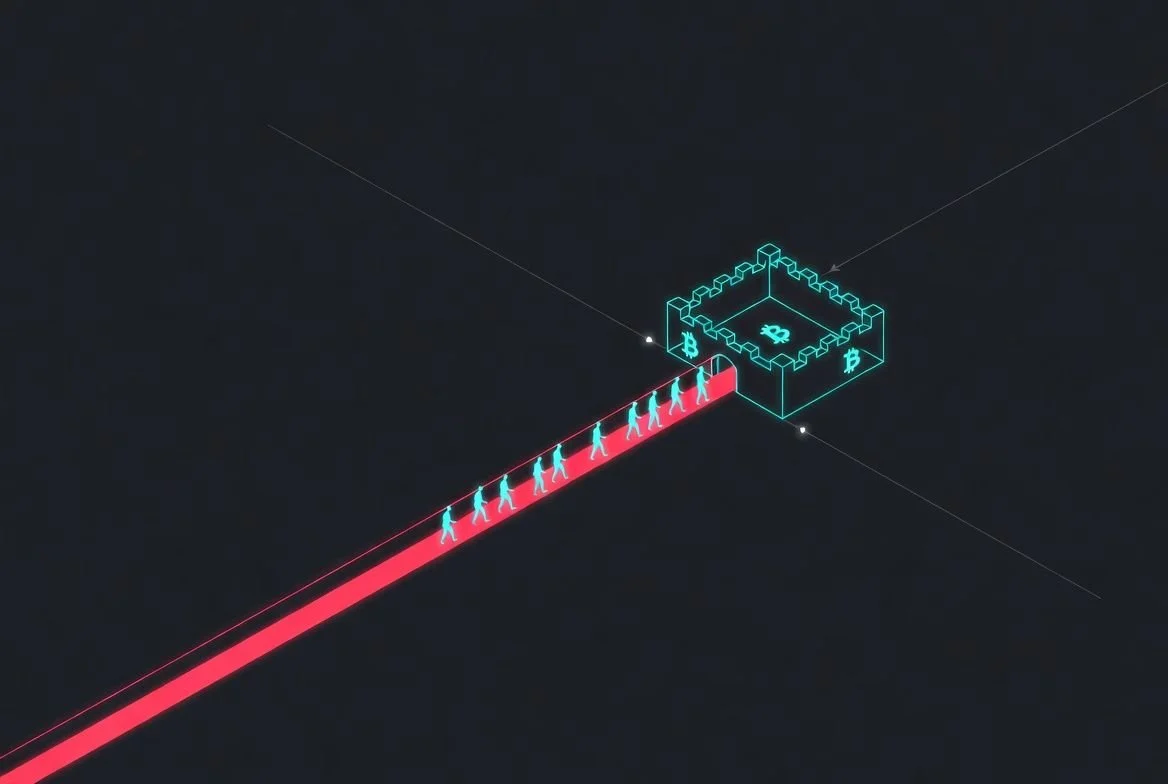
In the autumn of 2025, something very unusual happened on Bitcoin's network. Bitcoin Knots, an alternative implementation of Bitcoin’s node software, maintained by longtime developer Luke Dashjr, surged from around two percent of the network to more than twenty percent in a matter of months. Thousands of people who had been running Bitcoin Core, the dominant implementation for the protocol’s entire history, made the switch.
The trigger was a decision by Bitcoin Core maintainer Gloria Zhao to merge a change relaxing the default limits on how much non-financial data could be embedded in op_return outputs before a Bitcoin transaction would become non-standard, from the point of view of mempool relay policies.
Critics argued it would legitimize and accelerate the use of Bitcoin's blockchain as a dumping ground for data, like inscriptions, at the expense of its function as a monetary network. Supporters argued it reflected market reality and that opposing it was a form of censorship. The word “censorship” appeared in a public letter defending the change, signed by thirty-one Bitcoin Core contributors.
What the public debate mostly missed was the origin story. How did Gloria Zhao become the person who merged that change? How did Bitcoin Core, a project with no company, no CEO, no formal hierarchy, come to be directed, in practice, by a small and unusually cohesive group?
This investigation, across four articles, documents how that happened: how a network was built, how it was used, how its influence was encoded into the protocol's governance infrastructure, and what the consequences were when that influence was exercised at scale. This first article covers the foundation — the people, the institutions, and the sequence of decisions that assembled the network between 2018 and 2021.
It begins with a dinner.
The Dinner
Bitcoin Optech is a technical newsletter and education resource for Bitcoin developers, founded in 2018. It publishes weekly summaries of development activity, runs workshops, and organises occasional dinners for contributors. It is a respectable institution in the Bitcoin world. Low-profile, practically useful, trusted.
One of its co-founders is John Newbery.
Newbery is an English software engineer who became an active Bitcoin Core contributor in the mid-2010s. He is widely described, including by people who later fell out with him, as technically sharp, personally warm, and effective at navigating the social dynamics of a leaderless open-source project. By late 2020 he had accumulated a set of institutional levers that few people in open-source software outside corporate structures possess. He was a co-founder of Brink, one of the main organisations funding Bitcoin Core developers. He was closely affiliated with Chaincode Labs, the New York-based developer training program that had become the primary formal pipeline into Bitcoin Core. He co-organised Chaincode’s residency program alongside its CEO, Adam Jonas. He ran the Bitcoin Core PR Review club, a weekly session for mentoring contributors through the review process. And he ran the Optech dinners.
Optech was not self-funded. Its seed capital came from three individuals: Wences Casares, the founder of Xapo; John Pfeffer, a venture capitalist; and Alex Morcos, co-founder of Chaincode Labs itself. Two years later, Casares and Pfeffer would provide Brink's founding sponsorship. The same private funders financed the network's technical education arm and its developer funding arm in sequence. Steve Lee, an Optech co-founder, described its political function explicitly: Optech was built in part to facilitate the "post-SegWit2X healing process." It was both a technical newsletter and an institutional bridge, funded by the same people who would later fund the organisation that employed the developers.
Chaincode is also worth pausing on. Founded in 2014 and funded privately, it has run a series of developer residency and seminar programs that have produced a significant fraction of the people who work on Bitcoin Core today. It does not publish its selection criteria. It does not hold open applications in the conventional sense. Getting in requires knowing someone, or being known. Several of the current and recent Bitcoin Core maintainers passed through Chaincode’s programs. It is, in the language of academic hiring, a feeder institution, and Newbery was one of the people who ran the feed.
At one of those Optech dinners in early 2019, Newbery met Amiti Uttarwar.
Uttarwar had applied to Chaincode’s developer residency in 2018 and been rejected. She was working at Coinbase as a full-stack developer, having studied information systems at Carnegie Mellon. She had previously laughed off the idea that she could work on Bitcoin Core full time. It had always felt, she said later, like something other people did, not her. Newbery, over the course of that dinner, convinced her otherwise.
“John Newbery created an opportunity, broke it down for me into related achievable steps. Once on-boarded, I was able to meet new people, reach out, discuss ideas. Having that initial boost of confidence and some guidance for where to channel my initial efforts was enough to get me started and going.”
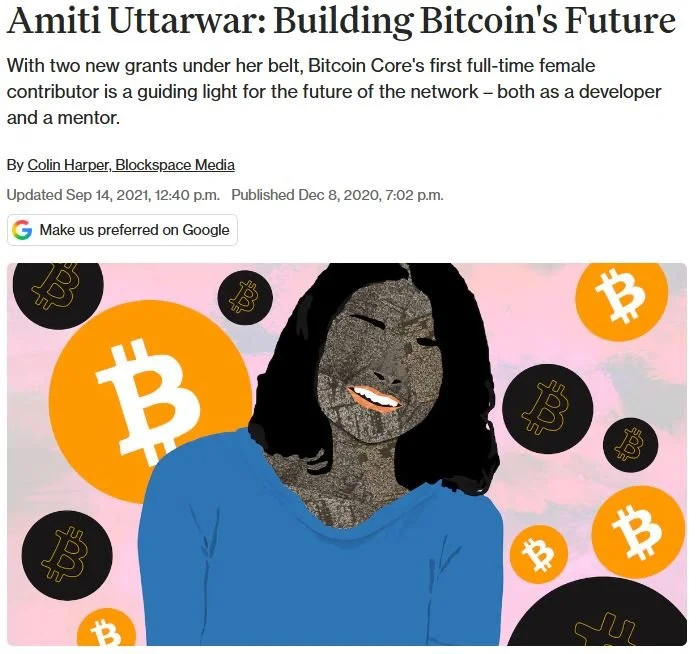
She described it as “a pivotal night for her career.” After that dinner, Uttarwar applied to Chaincode's residency again. This time she was accepted.
The sequence is documented in a Coindesk profile published in December 2020: rejected 2018, met Newbery at dinner, accepted 2019. The Coindesk article presents this as an inspiring origin story. It is also a data point.
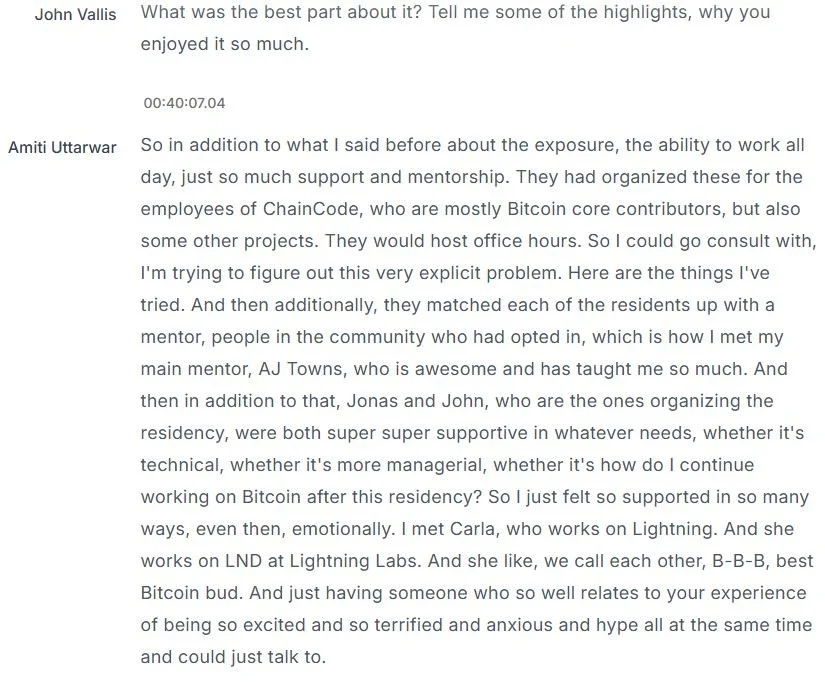
Bitcoin Rapid Fire Podcast, August 2020
The co-organiser of the residency she was accepted to the same year as meeting Newbery, was Newbery himself. Uttarwar confirmed this on the Bitcoin Rapid Fire podcast in August 2020: “Jonas and John, who are the ones organising the residency, were both super super supportive.”
She also credited Newbery and Jonas directly with arranging her first grant, from the cryptocurrency company Xapo: “I think John and Jonas played a part. My mentor, AJ, was working at Xapo at the time, so I'm sure he was part of it.” Her Chaincode mentor during the residency, the developer AJ Towns, was also Xapo-sponsored, and became her official manager at that company. The mentorship relationship converted directly into a formal employment relationship at the same institution. Towns also sat alongside Uttarwar on the Coinbase Crypto Community Fund advisory board.
In most professional worlds, this kind of network navigation is unremarkable. What makes this pattern worth examining is the precision of the sequence: rejection, then a social encounter with the man who co-ran the program, then acceptance, then funding arranged by the same man.
The Email
In January 2020, Gloria Zhao was 21 years old, a computer science senior at UC Berkeley, and done with Bitcoin.
She had grown up in Cupertino, in the heart of Silicon Valley, where the ambient culture is startup mythology and the local success stories are Apple and Google.
She had been president of the Blockchain student organisation at Berkeley, but by the end of 2019 her enthusiasm had evaporated.
Her disillusionment did not come in the form we would expect from a Bitcoiner though. In a podcast interview that autumn she described where she had been: "I was feeling really disenchanted with blockchain and Bitcoin in general. I've been disappointed over and over again by all these blockchain projects. Every year is supposed to be the year where we move away from proof of concepts and actually deliver on the products that all those ICOs promise to build. And it just never happens."
She used the word "blockchain" throughout, not "Bitcoin." In the community where the Chaincode Labs network operated, that distinction was not trivial. Committed Bitcoiners say Bitcoin. “Blockchain” signals someone who has no mental separation between Bitcoin and the broader crypto and ICO ecosystem. She had applied to Chaincode's residency and not been accepted. She had lined up interviews at Google and Facebook. She was, in her own words on the Stephan Livera podcast, planning to "completely remove any mention of blockchain on my resume."
Then, in January 2020, Adam Jonas emailed her.
Jonas is currently the CEO of Chaincode Labs; at the time of the residency he was its Head of Special Projects. He was hired into the company by John Newbery. Before Chaincode, he had worked at the Flatiron School, a New York institution that makes diversity, equity, and inclusion the explicit organising principle of its public identity. It operates race- and gender-gated fellowships, a dedicated DEI Taskforce, and cohort bonding sessions under the name "Feelings Friday".

The 2019 residency, the first Jonas co-ran at Chaincode Labs, included structured “Feelings Friday” sessions.
“We have Feelings Friday [at the residency], and it’s at 4:30 on a Friday. And we all grab a beer and we unload our week’s emotions. And we go around the circle and everyone says what they’re thinking and no one replies. It’s just really much like a release for everyone to stay sane in this crazy process.”
Jonas’ relationship with Flatiron runs deeper than employment: he was a student there in 2012, its founding year, being one of the first people the school trained. He learned to code at Flatiron, rose to Director of Engineering, and was shaped professionally by the institution before Newbery hired him to Chaincode Labs.
Newbery was explicit, on the public record, about why Jonas got the job: "Jonas's background is in education. He was working in the Flatiron School and managing teams and projects there. So he has a lot of experience putting together these programs." (John Newbery, Breaking Bitcoin Conference, Amsterdam, September 2019. Interview by Max Hillebrand, World Crypto Network.)
The qualification mentioned by Newbery was programme architecture from that specific institution, not Bitcoin knowledge.
That architecture included selection. In the same period, Jonas had conducted the residency interviews. One of the applicants was Jon Atack, a developer who would go on to become one of the four to five most prolific contributors to Bitcoin Core in the world by volume. Jonas interviewed him and told him within the first few minutes, in Atack's own words, that "they would not be moving forward with my application despite my extensive experience because they were looking for long-term contributor material and I wasn't it."
Atack spent the following months working on Bitcoin Core independently, unpaid. By the time Jonas emailed Zhao, who had no contribution history and told Jonas she was not interested, Atack had already done more review and commits in Bitcoin Core than the entire residency cohort combined. It would take him thirteen months to receive his first grant.
Asked to describe the funding outcomes of the 2019 residency cohort in March 2026, Atack provided a precise account. The cohort comprised approximately seven male residents, three male guests including Atack himself, two female residents, and one female guest. By August 2019, within weeks of the residency ending, both female residents had full-time funding offers: Uttarwar from Xapo, mentored by AJ Towns, who was himself Xapo-funded at the time; Kirk-Cohen via an offer from Chaincode Labs, which she turned down to join Lightning Labs shortly after.
Of the seven male residents, only one, Antoine Riard, the youngest participant, received any offer at all, to join Chaincode Labs directly. No other male resident found funding.
One year later, in the summer of 2020, Atack remained the only other guest or male resident who had found funding, after thirteen months of unpaid work. By that point, Gloria Zhao had been funded straight out of Berkeley to a fellowship in London with John Newbery at Brink, the organisation's first ever fellow, along with funding from Square Crypto and others following quickly. The first male resident funded by Brink came three years after the residency. Atack's own contribution ranking in that period: fourth globally by commit count in 2020, fifth in 2021. When Zhao was selected as Brink's first fellow in December 2020, she did not rank in the top twenty contributors by commit count; she ranked ninth in 2021, her first full year.
Jonas's email to Zhao noted that she had applied the previous year and had been "pretty close," and offered to arrange a coffee chat at the upcoming Stanford Blockchain Conference with "some Chaincode Bitcoiners." Zhao's initial response, in her own words, was: "nah,nah, I'm good. I'm done."
Jonas followed up with a phone call. She told him directly: "I don't really know, Jonas. I'm not that interested." He arranged the Stanford meeting anyway. She agreed to go, partly out of curiosity. She expected to meet, she recalled later, "nutty Bitcoin maximalists."
She expected maximalists and arrived with a list of grievances to test them on. What she brought to that door is documented from before the pipeline reached her. In June 2019, seven months before Jonas's cold email, Zhao published an essay in the Blockchain at Berkeley publication titled "Digital Panopticon: Why Privacy is a Human Right." Its bibliography is explicitly cypherpunk: Julian Assange's "Cypherpunks: Freedom and the Future of the Internet," Eric Hughes' "A Cypherpunk's Manifesto," Alexander Galloway's "Protocol: How Control Exists after Decentralization." She had read the foundational texts. She cited them by name.
The surface framing is cypherpunk. The argument is not. Hughes' manifesto states plainly: "We cannot expect governments, corporations, or other large, faceless organizations to grant us privacy out of their beneficence." His answer is cryptography, individual tools, trustless systems, code that enforces privacy without requiring institutional goodwill.
Zhao cites Hughes and arrives at a different conclusion: "the right to privacy must be respected and protected by the empowered." That is a regulatory, institutionalist argument. She is calling for the powerful to protect people, not for individuals to protect themselves through technical means. The cypherpunk reads the panopticon and builds a tunnel. Zhao reads it and writes to the prison governor about his obligations.
The specific harms she focuses on in the essay are equally telling. According to her, the main problem of the surveillance dystopia is not state coercion, not financial censorship, not the erosion of individual sovereignty, not any of the harms a cypherpunk would focus on. Zhao’s focus is instead that algorithmic systems reproduce racial, gender, and socioeconomic stereotypes. The closer she gets to naming the specific injury, the more precisely it resembles the progressive algorithmic-fairness framework dominant in Berkeley computer science in 2018–2019, not the threat model of the cypherpunk tradition.
This is the earliest documented primary source establishing the value system she brought into Bitcoin Core. It predates her recruitment by seven months, which makes it more useful than post-recruitment statements: it shows the framework arriving with her, not being acquired through the network. She read the cypherpunk canon and derived from it a political philosophy structurally opposed to what that canon argues. She then became a maintainer of cypherpunk infrastructure.
At the door to the network, instead of nutty maximalists she met John Newbery and Amiti Uttarwar.
“I met with Amiti Uttarwar and John Newbery on a very fateful day and they’re not what I imagined. And you know, John, he says in his very soft, British voice, he goes, Oh, I work on Bitcoin Core, the most interesting project in the world..[….] And I basically sit there for three hours and they very kindly let me pick their brains.”
Uttarwar told her to clone the repository and try it. That weekend, Zhao spent eight hours on it. It worked. She describes the moment as being "unplugged from the matrix."
In a second interview the same month, on the Bitcoin and Co podcast with Austrian journalist Anita Posch, Zhao named without prompting all three people who had brought her in: "some of the Chaincoders, including Amiti, and Adam Jonas, and John Newbery, got me into Bitcoin Core." She also mentioned, almost in passing, that she had "not personally thought about the money that much”.
Also on the Anita Posch podcast, she answered a direct question about what most people overlook in their thinking about Bitcoin, and what is missing in the public discourse about Bitcoin. Her answer: “We want Bitcoin so that we can use it, not so that we can sell it for more fiat... I think it's time for everyone to have a more socially-driven bottom line.”
This was October 2020. She had been contributing to Core for mere months. She was not yet funded. She was instructing the existing Bitcoin community on what their values should be. The framing positions her social-values framework as more advanced than the monetary conservatism of established Bitcoiners, even before she had earned any institutional standing from which to make that case.
Just a month after Zhao’s podcast interviews, in November 2020, the developer funding organisation “Brink” launched publicly. It was co-founded by John Newbery. What the launch announcement did not mention was that Brink had been intellectually conceived by Jonas.
On October 16, 2020, thirty-eight days before the launch, Jonas published a post on his personal blog arguing for a trusted nonprofit intermediary to fund Core developers. Two days later he published a detailed operational blueprint for starting a Bitcoin 501(c)(3): IRS process, approval timelines, legal gotchas, template filings. The closing line was: "Please do this."
On launch day, Newbery told Jonas publicly on X: "Your initial research was what got the whole thing started." That acknowledgment, made to Jonas directly, on November 24, 2020, is the only on-record confirmation of Jonas's founding role. It does not appear in any Brink public materials, its IRS filings, or its launch press coverage.
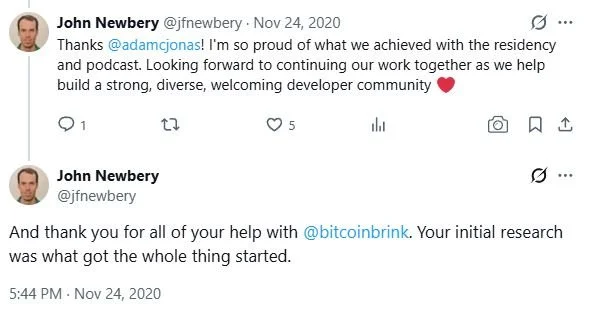
Just one week after launching, Brink announced its first fellowship recipient. It was Gloria Zhao.
The pipeline from Jonas cold-emailing a Zhao who was disillusioned with blockchain and “ICOs not delivering on their promises”, to Zhao being announced as Brink-funded developer, ran approximately nine months. The fellowship was announced the month she graduated, Jonas had cold-emailed her in January 2020 while she was still a student.
Zhao was candid, on the Livera podcast, about the nature of the support she received: mentorship from Newbery and Uttarwar that extended well beyond the technical. "They offer a lot of mentorship of course, technically, but also like, what should I do when someone has something kind of mean to say, or like, how do I address this like negative feedback? How do I get myself into an emotional state where I can accept criticism better?" She credits this explicitly for keeping her in the project: "I don't know if I would still be here if these people hadn't been so nice to me."
What the Livera podcast account did not mention, and what Brink's own institutional record confirms, is that during her first year as a Brink fellow in 2021, Zhao moved to London. Newbery is London-based. Brink's own blog post celebrating Zhao's four-year anniversary states the fact plainly: she was "mentored by Brink co-founder John Newbery and moved to London to establish our office there."
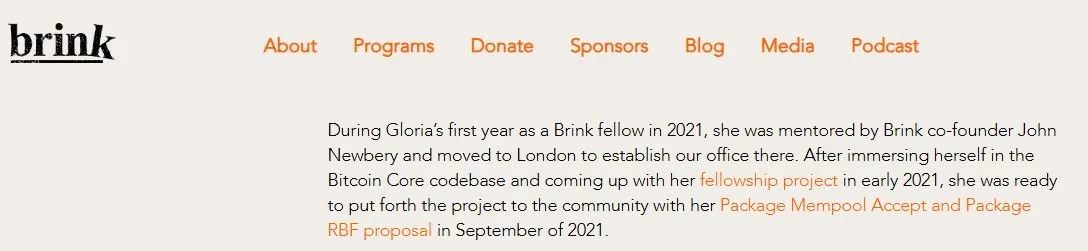
The mentorship that Zhao credits with keeping her in the project was conducted in the same city as the man conducting it, for the entirety of her fellowship year.
Brink has publicly described its engineer selection as governed by a "separate grant committee with independent members." Schmidt cited this committee repeatedly on the public record: in April 2023, defending Brink against charges of centralised control; in June 2023, describing the committee and board as joint authorities over fund usage; and in January 2024 — answering a direct question about who decides which developers get funded — naming four committee members: himself, Gloria Zhao, Christian Decker, and David Harding.
Zhao herself was simultaneously a Brink grant recipient and a grant committee member. Current board member, Jonathan Bier, confirmed in March 2026 that Zhao sat on it from March 2023 to March 2025, reviewing grant applications for other developers while herself funded by the organisation.
Brink's own IRS filings shows no existence of a grant committee. Schedule O of the Form 990 explicitly states "The Organization did not have committees", not once, but in every single filing from FY2020 through FY2023, the entire span across which Schmidt was publicly citing the committee as a governance safeguard.

The FY2023 filing declaring no committees was submitted to the IRS in November 2024, ten months after Schmidt had publicly named the committee's members.
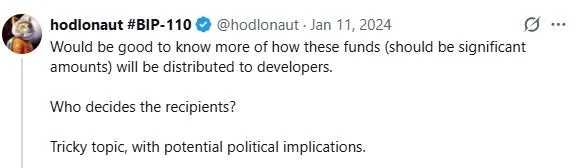
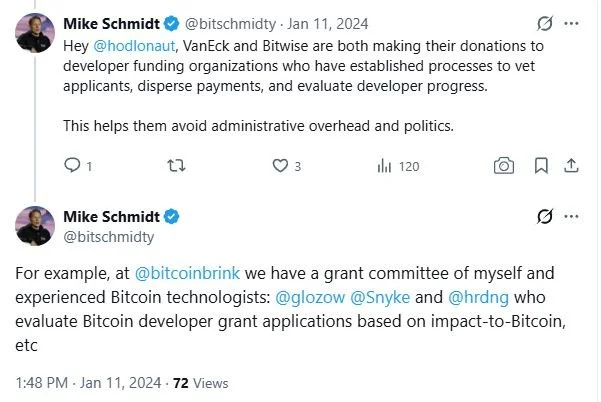
In his right-of-reply response, Schmidt offered an explanation: the committee is "Non-Governing" because the board technically approves its recommendations, meaning it falls outside the 990's reporting requirement, which applies only to committees with authority to act on behalf of the governing body.
Current board member Jonathan Bier confirmed that since joining the board, no grant committee recommendation has ever been rejected. The oversight layer exists, but it has never been used. No grant committee is documented in any formal record covering the period of Zhao's selection. The decision was made by a three-person board: Newbery, Schmidt, and Harding, confirmed by Schmidt in a formal right-of-reply response in March 2026.
Newbery's explanation for why he chose those two men is on the record. On the Stephan Livera podcast at Brink's launch: "I worked with Mike and Dave before and I trust them and I know that they do really great work. So when I was thinking about who I wanted to work with on this new project, it's people that I trust and know do great work. So there's an overlap." The overlap he describes is Optech, both Schmidt and Harding had worked with Newbery there before Brink existed. The board he assembled to govern Brink was built from his own prior network, on his own stated criteria of personal trust.
The third board member, David Harding, adds a further dimension. Harding is a Bitcoin technical writer who had no prior relationship with Zhao. He is also the same David Harding who, five months after casting his vote, authored the three-point plan to remove Luke Dashjr as BIP editor, a campaign Newbery publicly endorsed and executed on the mailing list. The board that selected Brink's first fellow consisted of the man who recruited her, the man he trusted from Optech, and the man who would five months later help coordinate the removal of an independent developer who had been critical of the network's direction. All three are listed in Brink's IRS filings as its founding directors. No governance process assessed whether any of this created a conflict.
Newbery, the man who recruited Zhao, introduced her to the network, and mentored her for nine months, cast one of the three votes that made her Brink's first fellow. No conflict-of-interest process was followed.
This has been confirmed by two board members independently: Schmidt stated on the record that no board member suggested recusal, characterising the relationship as merely "having worked together for several months". Bier confirmed he was not briefed on the conflict question when he joined and that to his knowledge no recusal process occurred. The governance safeguard cited publicly by Brink did not exist at the time it was needed. When it was eventually created, it was structured so that its recommendations have never once been overruled, and so that it need not appear in federal filings at all.
The Mirror
Place the recruitment stories of Amiti Uttarwar and Gloria Zhao side by side, and the structure is almost identical.
Uttarwar applied to Chaincode in 2018 and was rejected. Zhao applied to Chaincode in 2019 and was rejected.
Uttarwar met Newbery at an event he co-founded and ran; Zhao met Newbery at a meeting Newbery and Jonas arranged specifically for her.
Uttarwar described her first Newbery encounter as “a pivotal night for her career.” Zhao called her first Newbery encounter “a very fateful day.”
Both were accepted to Chaincode’s programs within a year after meeting Newbery. Uttarwar received funding that, by her own account, Newbery and Jonas arranged. Zhao became Brink’s first fellow immediately after Newbery co-founded it, and Newbery cast one of the three votes to make it happen.
Both described Newbery as the person who personally guided their early steps in Bitcoin Core development. And Uttarwar, once established, became the person who guided Zhao’s.
In the CoinDesk profile of Uttarwar published in December 2020, the same month Zhao was announced as Brink’s first fellow, the pipeline is described with unusual directness.
Uttarwar now has “her own school of mentees who, like her in those earlier days under Newbery, are searching for guidance through Satoshi’s labyrinth.”
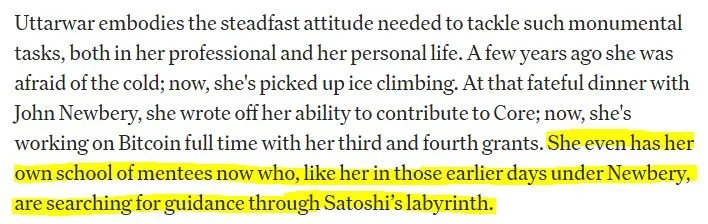
Screenshot from Coindesk
The pipeline is self-replicating, openly described as such by a major crypto outlet, framed throughout as an inspiring story about breaking barriers in a male-dominated field.
The question this story is asking is not whether these were good developers. It is how the selection mechanism worked, and whose judgment it primarily reflected.
Uttarwar herself was asked this question directly, or something close to it. On the Anita Posch podcast in June 2020, asked whether any entity had disproportionate influence over Bitcoin Core, she dismissed the concern entirely: “I don’t really buy into it at all.”
She had been in the space for little more than a year. But she was already funded by Xapo, recruited by Newbery at his own Optech event, mentored by AJ Towns who was simultaneously her Xapo manager, with her funding arranged by Newbery and Jonas by her own account. She was, at the moment of dismissing the concern, a product of precisely the kind of institutional network the question was raising.
She could not see it because she was inside it.
Four years later, Zhao offered the same assessment from the same position. On the Stephan Livera Podcast in October 2024, she described the Bitcoin Core development environment: "I think this is as close to like an actual meritocracy as I've ever seen."
She was recruited by cold email from the CEO of Chaincode, accepted to a residency the year after meeting Newbery at his own dinner, funded as Brink's first fellow in a vote Newbery cast without recusal, and appointed maintainer nineteen months later. This is the closest thing to a meritocracy she has ever seen.
What the pipeline had already produced was visible, as early as May 2020, in the space of a few hours. A new, prolific contributor named brakmic on GitHub, who had been actively working on pull requests, closed all ten of his open PRs and left the project in a single afternoon. The trigger was a comment from Amiti Uttarwar, suggesting he might consider "giving others a chance" at the beginner-friendly tasks he had been working on. She had no formal authority over contributor access. She did not need it. Her comment carried the weight of someone the project's funding network had been building for eighteen months, and brakmic felt it.
He replied that he wasn't aware there was a limit, and that if there was, there were other open source projects. He closed his PRs and was gone within hours. Seven senior contributors, including some of the most respected names in Core, posted publicly to defend him. Uttarwar apologised. Brakmic did not return.
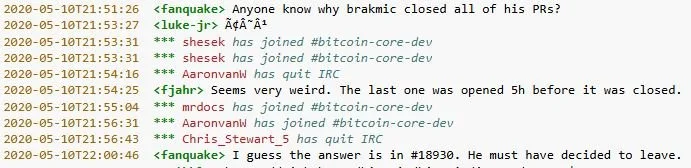
What Uttarwar could not see, and what the network had not given her reason to question, was the weight her words now carried.
This is what networks do: the people inside them experience them as fair.
The Armor
Before any of this became visible as a pattern, someone was already articulating it as a programme.
Matt Corallo is a longtime Bitcoin Core developer who had founded Chaincode Labs' developer residency in 2016 before handing it to Newbery.
In April 2018, a year before Uttarwar met Newbery, two years before Zhao did, Corallo posted a thread on Twitter explicitly calling for Bitcoin community outreach to underrepresented groups. "It's long since time the bitcoin community spent a ton more effort on recruiting and ensuring underrepresented groups (incl women and especially folks with a different background) feel welcome in the community," he wrote.
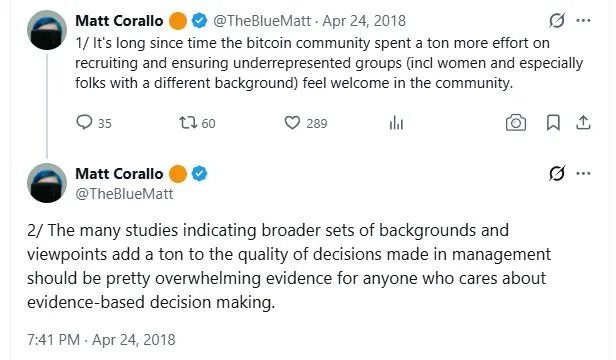
He framed it not as ideology but as evidence-based quality improvement: "The many studies indicating broader sets of backgrounds and viewpoints add a ton to the quality of decisions made in management should be pretty overwhelming evidence for anyone who cares about evidence-based decision making."
When a critic called the thread "social-Marxist ideology," Corallo blocked him.
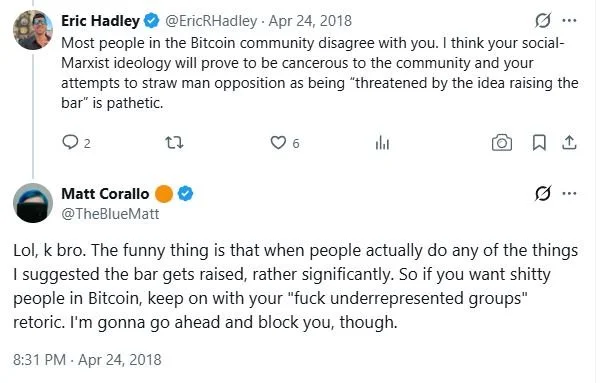
The ideological framework that would later shape developer pipeline decisions was being publicly articulated by a senior network figure two years before the pipeline produced its most consequential results.
In the summer of 2020, the forging of the armor that would protect that pipeline began.
In the weeks following the George Floyd protests, someone proposed changing the word “blacklist” to “blocklist” in Bitcoin Core’s codebase, a cosmetic change with no technical function, explicitly framed as a language sensitivity update. For a project that holds an unusually high bar for any modification to its software, the change was a notable accommodation to external social pressure. More than 100 people who had never previously contributed to Bitcoin Core arrived on GitHub to object. Uttarwar, who had reviewed the PR, received heavy criticism.
On the What Bitcoin Did podcast, the largest Bitcoin podcast in the world at the time, Uttarwar described the episode at length. She called the objectors “extremely extractive.” She described them as “a small group of loud, angry voices” who didn’t represent the Bitcoin community. She dismissed their GitHub participation as categorically illegitimate because they had no prior contribution history.
McCormack, to his credit, said on record: “I’m in the area of saying it shouldn’t have been changed for a political reason, let’s just keep politics out of Bitcoin.” Uttarwar did not engage with this directly.
This is the rhetorical template. Critics are toxic, unrepresentative, not real contributors, motivated by social media anger rather than technical concern. In 2025, the same language was deployed at scale during the OP_RETURN dispute. It was road-tested here, in October 2020, on the world’s largest Bitcoin podcast. The pipeline and the armor were being built simultaneously.
The word “extractive” did not emerge independently. It comes from Nadia Eghbal’s 2020 book Working in Public, a study of open-source software communities, in which Eghbal distinguishes contributors who give to a project from “extractive” users who consume it without contributing back.
Newbery confirmed on the Stephan Livera podcast the following month that a group inside Bitcoin Core had read the book and arranged a direct call with the author: “A few of us in bitcoin core had a call with her because we found the ideas in her book interesting.”
Within weeks, both Uttarwar and Newbery were using the word publicly, in separate interviews, applied to the same class of critics. The shared vocabulary was not a coincidence. It was sourced to a specific book, discussed at a specific internal call, and then deployed. Newbery, according to Atack, had strongly recommended his mentees to read it, Uttarwar being among them. Key parts of the framing that would absorb the backlash of 2025 had an intellectual origin and a transmission mechanism.
The formal governance infrastructure followed the same logic. A full Code of Conduct pull request had been proposed for Bitcoin Core in January 2023 and closed on the grounds it would create "the possibility of appearing to have a central authority." One contributor's objection cut to the point: the CoC was relevant "to the question of who is in control of Bitcoin."
Despite this, in May 2024, Adam Jonas authored Bitcoin Core's moderation guidelines. This is confirmed by IRC logs where maintainer Ava Chow told the weekly developer meeting on May 2, 2024: "ajonas wrote some moderation guidelines as a place for us to start thinking about this topic."

In the same meeting, a contributor named pinheadmz revealed he had already tested the guidelines against comments from the datacarrier size policy debate, the direct predecessor to the OP_RETURN controversy, using ChatGPT.
The moderation guidelines succeeded where the CoC failed because they bypassed the community process entirely.
Those guidelines now govern the GitHub repository where, within thirteen months following their introduction, they were put to use: Antoine Riard, a longtime Lightning developer, was banned on the same day he referenced a Chaincode cease-and-desist letter in a public comment on a Bitcoin Improvement Proposals pull request. Luke Dashjr was muted on the OP_RETURN pull request after years of opposing the policy direction it represented.
According to Atack, speaking on the record in March 2026, the function the governance instruments served were: "They aren't used to protect the weak from the strong. They're used to protect the strong from being bugged by the weak and to pound out on them, get them out of the way."
The press coverage reinforced the armor. In July 2020, Forbes published a 3,000-word profile of Uttarwar under the headline “First Confirmed Female Bitcoin Developer Is True Face of the New American Dream.”
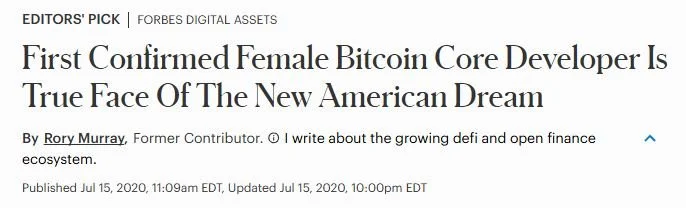
Technical substance occupied roughly three paragraphs. The rest was personal mythology: Indian immigrant family, elementary school fundraisers, yoga on mountaintops, the hero’s journey from rejection to Chaincode glory. The piece ran immediately after the announcement of a joint $150,000 grant for Uttarwar from BitMEX and OKCoin.
A Decrypt profile followed in December 2020, under the headline 'Amiti Uttarwar Is Blazing A Trail For Inclusive Bitcoin Development', the same week Zhao was announced as Brink's first fellow.
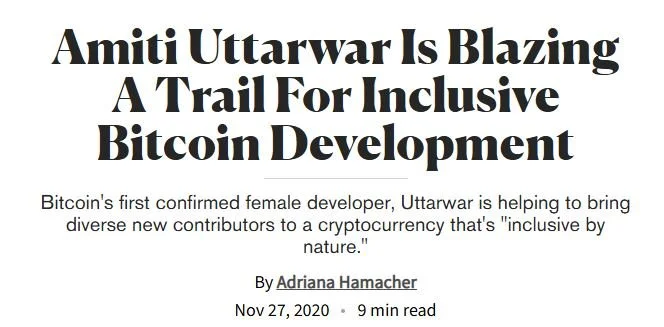
CoinDesk named Uttarwar to its Most Influential list in December, also the same month.
Whether this reflects coordinated media placement or a story compelling enough to pitch itself is a question this investigation has not yet answered. What is documentable is the function the coverage served: it built public profiles that made the subjects politically expensive to criticise, and framed the network’s activities as a diversity project, so that any challenge to the work product of people inside the network could be reframed as opposition to inclusion.
By the time a technical dispute arose, this framing would be fully in place. Anyone questioning the work of Uttarwar or Zhao would not simply be raising a technical concern. They would be opposing the first female Bitcoin developers. They would be one of the loud, angry voices. They would be extractive.
The armor works because it doesn’t require coordination to deploy. Once the framing is established, it activates automatically.
The cost was felt before anyone deployed it. In August 2019, immediately after spending two weeks at Chaincode Labs, Jon Atack asked to have his name removed from a Bitcoin book he had co-written. He described this in March 2026 as something that "remained a secret for 7 years." He self-censored continuously on social media and in conversations with Core colleagues, he says, on topics ranging from his politics to his views on other cryptocurrency projects, after learning at Chaincode that certain positions were socially costly. "I had to be very careful what I said and did during the two weeks at Chaincode in NYC," he wrote on the record.
That carefulness carried over to his code reviews and continued, by his account, until the present day. When a maintainer was later nominated for a role jonatack had reservations about, he abstained rather than raise them. Even abstention was read as hostile: "if you're not supportive and with us, you're against us." Those who did raise concerns, he says, "subsequently paid the price in the form of ostracization and disenfranchisement from core."
Newbery operated a personal Twitter account, separate from his Bitcoin-facing one, whose bio read: "Personal account. If you want bitcoin stuff, go to @jfnewbery." On it, between 2017 and 2020, he reposted Extinction Rebellion fundraising, Elizabeth Warren's "We believe her" on the day of Christine Blasey Ford's testimony, corporate diversity statements on the day of the George Floyd protests, a repost characterising Brexit voters as "racist foul fuckwits," a Joe Biden campaign post, and two Covid lockdown advocacy posts in a single day in March 2020, including one reading "Absolute disgrace. Remember this when the bodies start piling up.”
The ideological framework did not arrive in Bitcoin Core development by accident. The separation between his accounts kept his politics out of sight, not necessarily out of the room. The residency selected who it selected. The funding went where it went. Contributors who found certain views socially costly were not imagining the environment they were navigating, they simply could not see clearly where it came from.
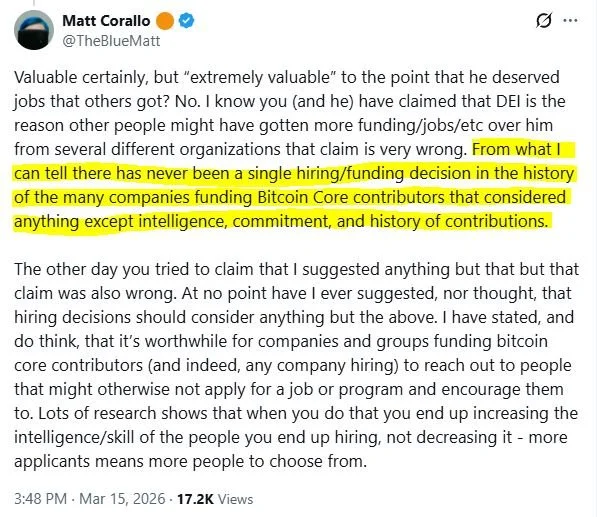
The framework was still being defended, and inadvertently confirmed, in March 2026, when Corallo entered a public thread on X to deny that DEI had ever influenced a single hiring or funding decision in Bitcoin Core development history.
“From what I can tell there has never been a single hiring/funding decision in the history of the many companies funding Bitcoin Core contributors that considered anything except intelligence, commitment, and history of contributions,” he wrote.
He then clarified what he meant by “commitment”: “By that I, indeed, meant commitment to working on Bitcoin for what it is and understanding of the philosophical underpinnings of it. I do believe that is often an important hiring criteria, and certainly the hiring decisions I’ve been a part of have considered it.”
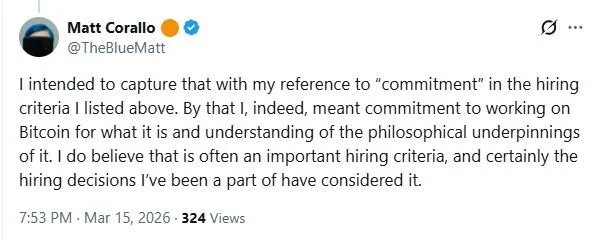
Three criteria, then, by his own account: intelligence, philosophical commitment to Bitcoin for what it is, and a history of contributions. Never anything else.
The problem with Corallo’s claims is that the pipeline’s most consequential recruitment, initiated with Jonas’ cold email to Gloria Zhao in January 2020, is documented in Zhao’s own words, in two separate podcast transcripts from October 2020.
She had decided to leave blockchain, she said on the Stephan Livera podcast, "kind of at the end of 2019" and was "totally done." On the Anita Posch podcast the same month, she described her initial reaction to Jonas's email: "nah,nah, I'm good. I'm done." When he followed up by phone, she told him directly: "I don't really know, Jonas. I'm not that interested.
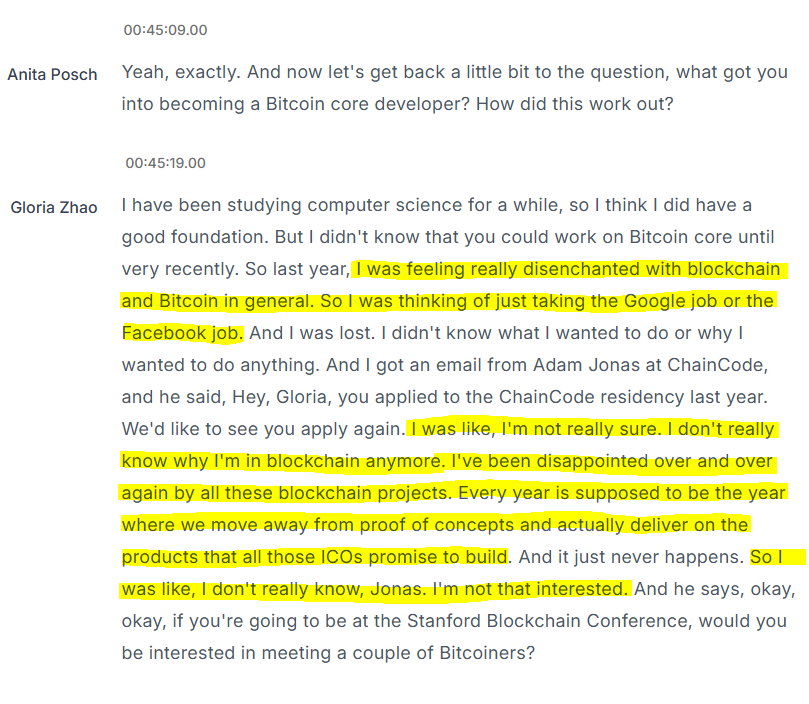
Jonas knew this. He arranged the Stanford meeting anyway. Philosophical commitment to Bitcoin, Corallo’s second criterion, was not present at the moment of recruitment. By Zhao’s own account it was explicitly absent. She was not a Bitcoiner. She was a blockchain person who had grown disillusioned with the blockchain space, because “ICOs hadn’t delivered on their promises”, and whose plan at the moment Jonas emailed her was to remove any mention of blockchain from her resume and take a job at Google or Facebook.
The third Corallo criterion, her history of contributions, was nonexistent. Two out of three criteria demonstrably absent, by the candidate’s own words, known to Jonas before he persisted. The question Corallo’s confident denial raises but does not answer is: what criterion was actually applied?
Corallo answered that question, without appearing to notice, in the same X thread. Defending the pipeline's legitimacy, he described how it actually operates: "For jobs they're often in-person and generally come after quite some time of regular interaction. You find out alignment socially over time. And, yes, funders tend to be highly aligned."
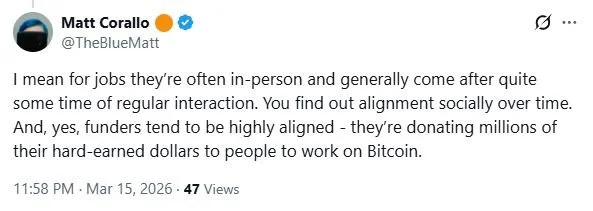
This is not a description of a meritocracy based on intelligence, commitment, and history of contributions. It is a precise description of how a social network assesses trustworthiness through relationship proximity, in-person interaction, regular contact over time, assessment of alignment through the relationship itself. It is also a precise description of what this article has documented: Optech dinners, Chaincode residencies, Feelings Friday, moderation guidelines, Jonas's follow-up calls. Corallo has named the mechanism he is defending. The people who found alignment socially over time were funded. The people who did not were not.
The Independent Contributor
By the spring of 2021, Jon Atack was among the five most prolific contributors in the project by volume, fourth globally by commit count in 2020, fifth in 2021. He had been contributing since 2019, the same year Jonas interviewed him for the Chaincode residency and told him within the first few minutes that they would not be moving forward with his application because they were looking for 'long-term contributor material' and he wasn't it. He had spent two years proving otherwise. He was not affiliated with Chaincode. He was not funded by Brink. In June 2021, he applied for a Brink grant. The rejection was communicated to him personally by Newbery, by phone call.
Months earlier, launching Brink in November 2020, Newbery had described his role in the funding ecosystem in terms that now looked different.
“If people fund Brink, they can be sure that money is going towards people who will make impactful contributions. And I will be able to make sure that they’re delivering on their promises… I know the history of all the contributors. I know the potential of new contributors. I’ve spoken to all of them, I’ve mentored some of them.”
“I think most protocol developers who I want to see funded are funded.”
In June 2021, Jon Atack raised a technical objection to a pull request authored by Amiti Uttarwar.
The PR proposed widening the semantics of a peer-to-peer network message before the underlying specification had been formally clarified, a sequencing problem with the potential to create long-term ambiguity in the protocol. Several senior developers eventually agreed with jonatack’s concern. The PR was withdrawn.
But before that happened, something else occurred that matters more to this story.
On IRC, June 16, 2021, the same day as jonatack's objection, Newbery responded to him dismissively. He used a sarcastic analogy and told jonatack he was "very confused" about the controversy. In the same IRC session, Newbery acknowledged publicly that he had personally directed Uttarwar's PR strategy: "I suggested to amiti that 22245 be separated from 21528, so I apologize if that was confusing for people and take full responsibility."
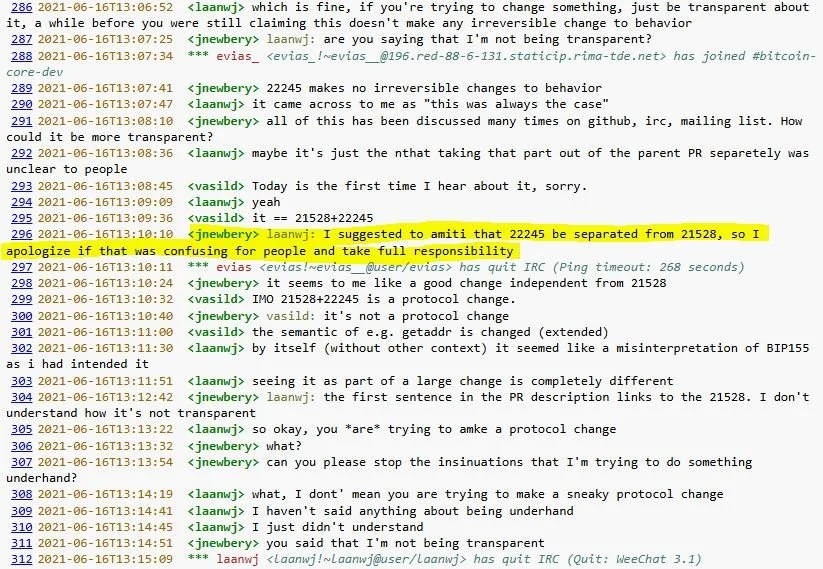
Jonatack's account, given on the record in March 2026, is that Newbery's aggression was not directed at him alone. He names three targets: himself, Vasil Dimov, and Wladimir van der Laan, the project's lead maintainer.
The IRC logs confirm what jonatack describes: directly after an escalating exchange in which Newbery accused van der Laan of charging him with dishonesty, the lead maintainer quit the channel.
What followed the public IRC episode, jonatack says, was a private conversation with Newbery on Slack. He describes it this way: "It wasn't outright angry, but it broke something fundamental.”
The PR carried Uttarwar’s name. The strategy was at least partly Newbery’s. Uttarwar is absent from the IRC channel during the subsequent two days while Newbery handles the dispute, then the reverse: Newbery goes silent while Uttarwar posts a long public defence on June 18. Jonatack later described the broader pattern in his PlanB presentation: “It got to the point where wagons would circle if you would question the wrong people or report a bug created by the wrong person. If someone friendly to that person had to find the bug and report it, it was all about wagon circling, gaslighting, ‘Oh, that’s not a bug,’ and then someone else would fix it quietly.”
The June 2021 episode was not the first time Newbery had used his institutional position against a contributor he perceived as hostile. In April 2021, two months earlier, a coordinated effort had emerged on the Bitcoin development mailing list to remove Luke Dashjr as the sole BIP editor.
BIPs (Bitcoin Improvement Proposals) are the formal documents that define changes to the Bitcoin protocol. Dashjr, a technically rigorous and sometimes abrasive longtime contributor, had held the BIP editor role since 2012. On April 26, David Harding posted a three-point plan: add Kalle Alm as co-editor, seek Dashjr’s resignation, and treat external protocol documents as alternatives. Harding noted his plan had been “developed based on conversations I had with a few stakeholders”, not disclosing with whom.
The following day, at 12:33 UTC, Newbery replied on the public mailing list: “ACK. These seem like very reasonable next steps.” He was endorsing, on the public record, a call for Dashjr’s resignation.
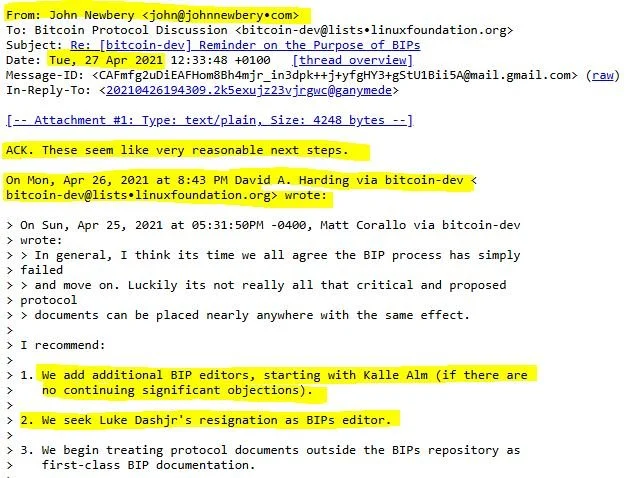
Weeks later he filed the GitHub pull request himself to install Alm as co-editor.
Two and a half years later, in December 2023, Harding returned to the subject publicly. In an X post that reached 169,000 impressions, he wrote that Dashjr "has cost valuable Bitcoin contributors more than most people can imagine," "manufactures controversies over inanities," and "I think he's been a net negative for Bitcoin." In a follow-up in the same thread he added: "Maybe then the millions he has recently received would've gone instead to the quiet, undramatic builders that really help move Bitcoin forward."
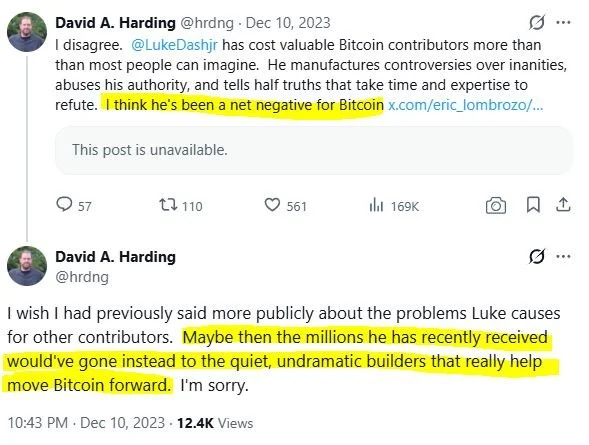
The man who co-designed the 2021 removal campaign, who cast one of the three votes to select Brink's first fellow, and who sat on Brink's grant committee, was publicly arguing, in late 2023, that Luke's funding should have gone to the network's preferred developers instead.
Two independent contributors, Dashjr and jonatack, who had crossed or been perceived to challenge the network, both found themselves on the receiving end of Newbery’s institutional leverage within a matter of months. The BIP editor campaign was public and on the mailing list. The jonatack confrontation was on IRC and, in part, private. Both are documented.
Jonatack later described the private exchange with Newbery as changing “everything for me after in core.” His contributions went, in his own words, from “top 3 most prolific in the world in 2019–mid 2021, to nearly nothing” in the aftermath. This decline is independently verifiable on GitHub.
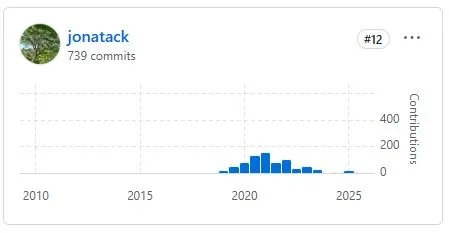
The git log data he later provided on the record shows top 4 in 2020, top 5 in 2021, meaning he was quoting from memory; the direction is confirmed.
But it was not only his own contributions that suffered. "Everything became much more difficult, not only for me, but for people who appeared friendly to me or who I was friendly with." The hostile reception extended beyond jonatack himself to anyone associated with him, a social punishment mechanism that the IRC logs alone cannot document, but that jonatack names on the record. He describes the result as "working with an immense handicap and permanent doghouse status." The word permanent matters. This was not a cooling-off period.
Years later he named what the loss had cost him at its deepest level. Wladimir van der Laan, whose leadership style had been Atack’s primary inspiration to come work on Bitcoin Core, and with whom he had worked closely through 2019 to 2021, stepped down as lead maintainer.
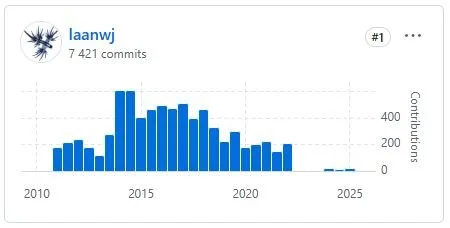
"Friendly support almost completely vanished," jonatack wrote. "This continues to this day in 2026, nearly five years later at the time of writing."
At the PlanB Forum in El Salvador in early 2026, Atack described in detail the structural dynamic he had experienced in Bitcoin Core, and some of it was unexpectedly corroborated from inside the institution itself. Jonathan Bier, a sitting Brink board member, responded to a formal right-of-reply in this investigation in March 2026. Unprompted, he volunteered: "I was in El Salvador listening to Jon Atack's speech in January 2026. I think Jon raised a number of valid points in his talk... One of Jon's points was that Bitcoin development has become too professional, with too many developers going into an office in a major city such as New York, San Francisco or London. There is a concern that this results in a professional office culture that may be out of touch with Bitcoin's cypherpunk roots and/or out of touch with the culture and economics in developing countries."
In December 2021, Newbery announced he was stepping back from Bitcoin Core development and from Brink. No detailed public explanation was given. According to two independent sources, Newbery did not leave voluntarily, he was removed by Brink's board. This account has not been confirmed on the record by Brink. Asked directly whether the departure was voluntary and whether the board conducted an internal review, Schmidt declined twice, characterising governance questions about a co-founder's departure as personal matters he would not address.
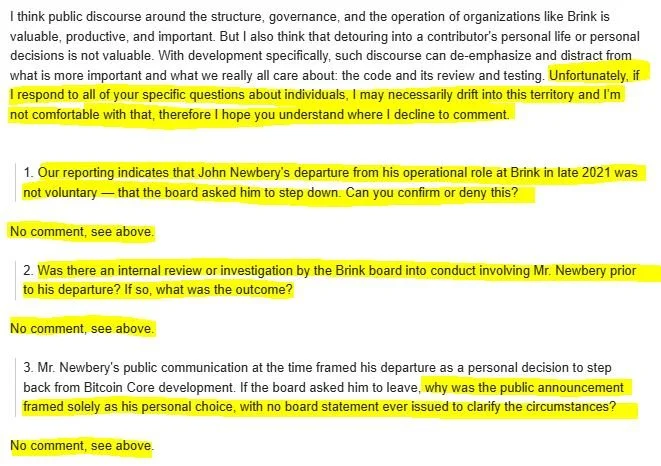
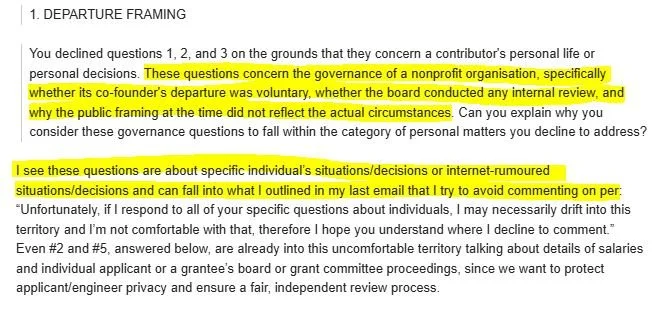
In the same year, Brink expanded its board to include Carla Kirk-Cohen — a 2019 Chaincode residency alumna whom Jonas had publicly described as "our poster child" of the developer pipeline, designated on Brink's public record as an independent director.
Brink's own IRS filing for that year adds a further complication: in FY2021, Newbery was the only person at Brink drawing any compensation above reporting thresholds, $359,044 in total, the largest single compensation payment to any individual in Brink's documented history.

In the prior year, FY2020, his listed compensation was $0. Schmidt, Harding, and every other board member reported $0 in both years. The board that allegedly removed him paid him $359,044 in the year they did so, having paid him nothing the year before.
Brink has offered an explanation. Schmidt stated on the record that "both John and I did significant work (time and expenses) to form Brink in 2020, work and expenses which were only compensated for later, in 2021", framing the payment as deferred founding compensation rather than severance. A second board member, Jonathan Bier, confirmed independently that when he joined the board he noticed the payment and queried it, and was told it "was booked in one year, but related to multiple years." Whether any portion constitutes severance for Newbery's departure has not been confirmed or denied on the record by either.
The Output
In July 2022, Gloria Zhao became a Bitcoin Core maintainer, one of a small number of people with the technical authority to merge code into the repository. She was just over two years out from her first encounter with Newbery and Uttarwar at Stanford, and nineteen months out from becoming Brink’s first fellow. The appointment was covered widely as a historic milestone: the first woman ever to hold the role.
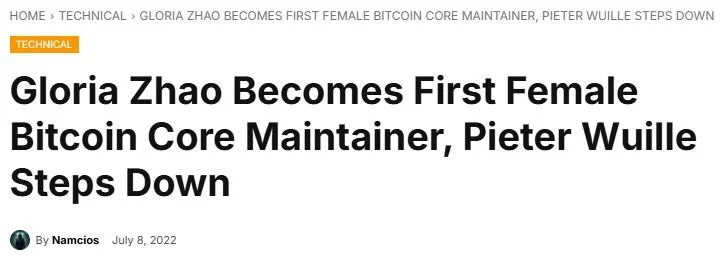
The nomination came from fanquake, Micheal Ford, a longtime maintainer who, by jonatack's on-record account, had been among the most hostile to his own work since June 2021. At the meeting where the nomination was confirmed, on June 30, 2022, another developer noted that Brink would now fund three of Bitcoin Core's maintainers.
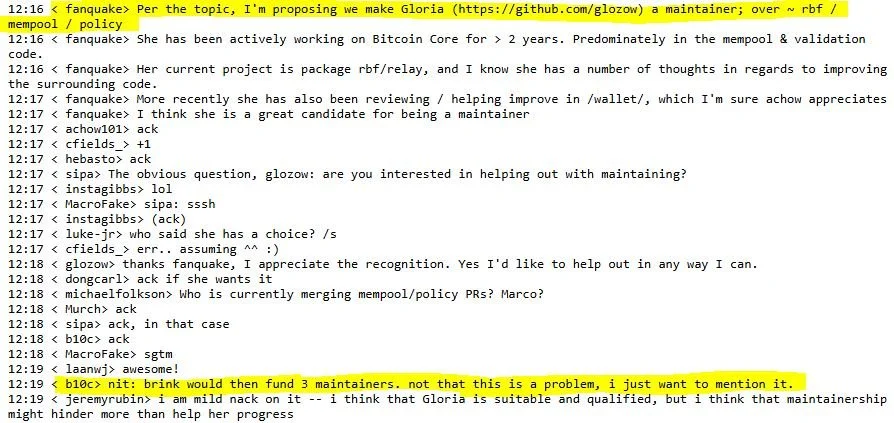
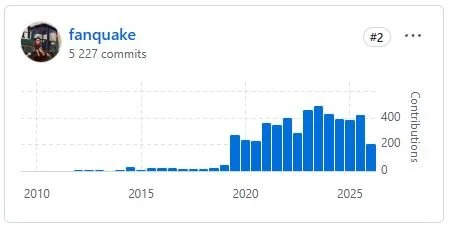
Fanquake, the same person who nominated Zhao for maintainership became, in the years that followed, the dominant force in Bitcoin Core merges. Brink's own published Engineering Impact Report confirmed that he had merged 56% of all changes to the project in 2025.
The speed of Zhao’s ascent is notable. Becoming a Bitcoin Core maintainer typically requires many years of sustained, recognised contribution.
Jon Atack, from his own years inside the project, described how such appointments actually worked: “In fact, maintainerships are practically pre-decided. It’s not based on a vote of the people at the IRC meeting. To become a maintainer, you have to be approved by the existing maintainers. And if you question or criticize that, you’re not a supportive person, and we’ve seen these people, and how they get moved out of the project.”
In early 2026, Jon Atack gave a public presentation at PlanB Forum in El Salvador. He had been a Bitcoin Core contributor for years, among the most productive by any objective measure at his peak. Atack was personally present at the June 2019 Chaincode residency as a guest, Uttarwar was there as a resident. Zhao would follow the same path the following year. He describes from firsthand experience what the selection criteria were at that moment:
“What was selected for was basically people willing to come in and work in the offices in the large blue cities of New York City and later San Francisco, mainly New York City. Chaincode Labs was the leader in working on the developer pipeline. The organizer of that program was previously a talent scout in baseball, so the analogy fits. And right before that program began in June 2019, in May 2019, Blue Matt, Matt Corallo, and others started online tweeting about a DEI push, a need for diversity. So we had a cultural change that began right as I was invited for the first time as a new developer to Chaincode Labs in New York City, and I saw with my own eyes how things were becoming Americanized. What that happened was that created a few people that were funded. The red carpet was rolled out for them and they got funding immediately, while the others who didn’t fit the identity characteristics struggled very, very mightily.”
In March 2026, Atack returned to the same point with greater geographic precision. Speaking with Knut Svanholm, he named London explicitly:
“If you’re selecting for young people who want to live and work in Manhattan or San Francisco, or later on, bring your office to London, you’re definitely going to be excluding the people like, let’s say, me, who doesn’t want to be in a big city... You’re excluding the guy with three kids who’s married, who has a mortgage to pay, who’s not going to up and move to the Chaincode Labs offices for a year. You’re excluding the guy like me who would rather be building a citadel in El Salvador or surfing in France. And so what kind of people are you left with — well, it speaks for itself what you’re going to get if you select for that.”
Jonas described his own function in the same terms, unprompted, three months after jonatack attended the residency. In a September 2019 interview at the Breaking Bitcoin conference in Amsterdam, he said he was spending his time “trying to develop a new wave of talent and new set of contributors.” What jonatack called a talent scout analogy was in fact an identification: Jonas’s actual career ran from professional baseball player development and scouting to software engineering management at Flatiron, before Chaincode. He was not like a talent scout. He was one.
By December 2020, the pipeline was operational. The Optech dinners had served their function. The cold email had been followed up with a phone call, then converted into a Stanford meeting, then into nine months of mentorship conducted in the same city as the man providing it. Brink had launched, governed by a board Newbery had assembled on his stated criterion of personal trust. Its first fellow was the developer that mentorship had produced.
What that pipeline was used for, between 2021 and 2025, is a separate story.
That is the story of the lever. It begins the following year, with a mailing list post, a GitHub pull request, and a confrontation on IRC.
A Note on What This Story Is and Is Not
This article does not claim that Gloria Zhao is not a capable developer. It does not claim that Amiti Uttarwar lacked technical ability. It does not claim that John Newbery or Adam Jonas acted with malicious intent. People in positions of influence recommend the people they know and trust. This is universal and not automatically corrupt.
What this story documents is a mechanism: a small network, centred on a single institutional node, that came to exert significant influence over who entered Bitcoin Core development, who received funding, whose technical objections were taken seriously, and whose were not. The mechanism is documented through the subjects' own public words, podcast transcripts, mailing list posts, GitHub logs, and published profiles. No anonymous sources are required to establish the basic structure. It is all on the record.
The question the evidence raises is whether a structure that concentrates this much informal power in this few hands is compatible with the stated values of a project that describes itself as trustless, decentralised, and open to all. The same mechanism that advanced some careers foreclosed others.
The network documented in this investigation reproduced exactly the kind of institutional capture that cypherpunk philosophy was designed to prevent, and it deployed the language of inclusion as its legitimating framework, so that challenges to the capture could be recast as opposition to those values.
Right of reply was sought from all named principals. John Newbery and Adam Jonas were contacted in March 2026 with specific questions; neither responded. Contact details for Amiti Uttarwar and Gloria Zhao could not be established through public records; both are named in this article and any response from either will be incorporated.
Bitcoin's answer, in 2025, was to move a fifth of its node network to different software. That is not a small thing. It is, in its own way, the protocol working as designed: when you lose the community's trust, they respond through their nodes.
Sources
Stephan Livera Podcast SLP216 (October 2, 2020); Stephan Livera Podcast SLP229 (November 18, 2020); Stephan Livera Podcast SLP607, Gloria Zhao (October 2024); Bitcoin and Co podcast with Anita Posch, Episode 82 (October 2020); What Bitcoin Did podcast with Peter McCormack (October 2020); Bitcoin Rapid Fire podcast with John Vallis (August 2020); What Bitcoin Did WBD134, Peter McCormack interview with Newbery, Jonas, Uttarwar, and Kirk-Cohen (July 26 / August 9, 2019); Breaking Bitcoin Amsterdam conference interview, Max Hillebrand with Newbery and Jonas (September 2019, World Crypto Network); Gloria Zhao, "Digital Panopticon: Why Privacy is a Human Right," Medium / Blockchain at Berkeley, June 1, 2019; CoinDesk, ‘Amiti Uttarwar: Building Bitcoin’s Future’ (December 8, 2020); Forbes, ‘First Confirmed Female Bitcoin Developer Is True Face of the New American Dream’ (July 15, 2020, Rory Murray); Decrypt, ‘Amiti Uttarwar Is Blazing A Trail For Inclusive Bitcoin Development’ (December 8, 2020); Bitcoin Magazine, ‘Gloria Zhao And Brink Are Set To Give Bitcoin Mempools An Upgrade’ (December 1, 2020, Aaron van Wirdum); Bitcoin Magazine, ‘Gloria Zhao Becomes First Female Bitcoin Core Maintainer’ (July 2022, Namcios); Bitcoin Core IRC logs, erisian.com.au archive (June 16–18, 2021); Bitcoin Core IRC logs, erisian.com.au archive (May 10–11, 2020); GitHub issue #18930, bitcoin/bitcoin repository (May 10–11, 2020); bitcoin-dev mailing list (April 23–27, 2021); Jon Atack, PlanB Forum presentation, El Salvador (2026); Brink Technology Inc IRS Form 990 filings FY2020–FY2024 (ProPublica Nonprofit Explorer); Mike Schmidt, Brink, formal right-of-reply response (March 9, 2026); Jonathan Bier, Brink board member, formal right-of-reply responses (March 16 and March 17, 2026); Matt Corallo (@TheBlueMatt), X, March 15–16, 2026 (public thread, 14,100 views, screenshots preserved); @hodlonaut, X, March 16–17, 2026 (10-tweet public thread synthesising Corallo contradiction, screenshots preserved); Jon Atack (jonatack), Old Man Yells with Bob Burnett, Episode 21, March 15, 2026 (public, on-record, full transcript preserved); Brink blog, "Celebrating Gloria's First Brink Epoch," brink.dev/blog/2025/01/04/glorias-brink-epoch/, January 4, 2025; Jon Atack (jonatack), Bitcoin Infinity Show #195 with Knut Svanholm, March 23, 2026; David A. Harding (@hrdng), X, December 10, 2023; Jon Atack (jonatack), written responses to formal questions, March 25, 2026; Brink, "2025 Engineering Impact Report," March 26, 2026. brink.dev/blog/2026/03/26/engineering-impact-report-2025/; public GitHub repositories (bitcoin/bitcoin, bitcoin/bips).
Right of reply has been sought from John Newbery, Adam Jonas, Mike Schmidt (Brink), and Jonathan Bier (Brink board). Schmidt responded on March 9 and March 17, 2026; his responses are incorporated above. Bier responded on March 16 and March 17, 2026; material from his responses is incorporated above. Right-of-reply requests to Newbery and Jonas remain outstanding at the time of publication. Contact details for Amiti Uttarwar and Gloria Zhao could not be established; both are named in this article and any response from either will be incorporated. This article will be updated to incorporate any further responses received.